October 2003
Project: The Arts of Bhutan
Sponsor: Honolulu Academy of Arts (HAA)
Project Director: Dr Stephen Little, Director, HAA
Our goal, over 5 years' time is to make a complete accounting of dances in the Kingdom, representing all twenty regions of Bhutan, as well as representing a complete year of ritual dance expression. Beyond this, our work is intended to produce video documentation and written work for placement in the New York Public Library for the Performing Arts Dance Collection, and as material accompanying the exhibition. In addition, our work includes organizing a traveling group of dancers from Bhutan to accompany the exhibition. Such illumination in the study of art as dance can provide will be brought forward by the work. Uniting two primary cultural expressions of Bhutan, namely, Art and Dance, is intended to produce a more accurate and vital depiction to the world of this rare and much unknown place, and the spiritual foundation upon which its culture is borne.
Landlocked in the eastern Himalaya, adjacent Tibet between China and India, Bhutan is unique in the world, having Tantric Buddhism as the State Religion. It is home to a range of ancient dances, from monastic to farcical, including never-before studied dances in isolated areas still possessing their own distinct spoken languages, themselves on the verge of extinction. Where there is ancient language, there is also the more ancient pre-language of movement, and the prospects of discovery are encouraging.
Being a 'closed' Kingdom, entry by foreigners is strictly controlled, as is foreign influence generally. Maintaining traditional ways of life is the highest priority of government. So being, the Kingdom of Bhutan has become increasingly a sanctuary of nature and culture in a region and world marked by instability and cultural devastation. There has been no formal catalogue of dances made in Bhutan; no real scholarship or movement analyses exist; documentation is limited to major festivals shot by television crews. This project, then, is truly an exploration of pristine and unknown ancient dances.
The coherence and continuity of the living tradition of ancient dances in Bhutan, connected in a still-whole cultural context of art, monasticism, mysticism, royalty, martial arts, secular dance, hunting, farming, healing, sport and ritual magic makes a comprehensive record of dance in Bhutan a possible 'baseline' of ancient Himalayan dance, and perhaps ancient dance generally. Bhutan is the only functioning Kingdom remaining in Asia, and one of very few left on earth. Dance is integral to way of life at every level.
"The Arts of Bhutan" is essentially an art and dance project sponsored by a museum, and is extraordinary for the stature and platform it gives to dance. Further, the project is unique in that the art aspect arises from a core project activity: training Bhutanese in art conservation using indigenous materials. Similarly, the dance aspect arises from a parallel core project activity: dance preservation by means of exploratory research and fieldwork; locating, cataloguing, and documenting the range of ancient dances.
Three of us traveled from London through Delhi and Kathmandu to Thimphu, the capital of the Kingdom. Joining our well-informed and impressively prepared local guide there, this 10-day, 4-man team attended two major dance ceremonies, each lasting 3 days. The first of these is the Thimphu Domcheons, a private danced ritual ceremony performed by and for Buddhist monks, and closed to the public. We were granted special permission to observe, but photography was not allowed.
The dances of the Domcheons were performed in sets of two each day, amounting to approximately 4 hours of dance. The stateliness of the dances truly derives from being performed as part of a state ritual in the Thimphu Dzong, which is the seat of the national government, home to a monastery and the residence of the Je Kempo, Head Abbott of all monasteries in Bhutan. Thimpu is the cosmopolitan, as well as the political and religious center of Bhutan. The King works in a tower within the Dzong and He was present, though not visible during the ceremonies. Two of His four Queens attended the ceremony on the second day, arriving and exiting with the appearance and disappearance in the dance of the Protector Goddess of Bhutan, Palden Lhamo.
Field Recorder Andrew Gordon succeeded in making extensive notes about these dances, working closely with our guide Tsewang Nidup. These are perhaps the only records or descriptions of these dances outside the Thimphu Dzong, certainly the only ones in any European language. His notes include identification of deities, duration of dance, basic dance structure and sequence, choreographic diagrams, and data on geomancy. They record the rpm of dancing turns, and the bpm of rhythm instruments; the altitude and precise geographic location. Particular repeating dance steps were notated, and ritual implements were described.
Joseph Houseal took notes of an interpretive, speculative and comparative nature within the context of other CoC work in the Himalaya. He observed with an eye toward devising a 5- year research and documentation strategy: avoiding duplication, identifying salient qualities of the dance, and forging the ongoing ability to compile various sorts of data into a useful whole. He looked for characteristics of the dance useful in illuminating Bhutanese art.
Gessie Houghton observed the ceremonies with an eye toward the logistic requirements of video and photographic documentation, once the formal approval for the project is granted and a proper, fully equipped production team is at work. While doing so, his observation of large pattern, nuanced detail, and the scale of the natural environment focused his look at the dancing.
Tsewang Nidup, a dancer himself as well as guide, escorted all outings, devised itineraries, translated ceremony programs extemporaneously during the performances and answered endless questions about iconography, history, and traditional practices. He demonstrated archery dances which were filmed. Throughout, he provided subtle insights into the dances, otherwise unnoticed by the first-time traveler to Bhutan. His readiness and enthusiasm are a reflection of the seriousness he too has toward this project.
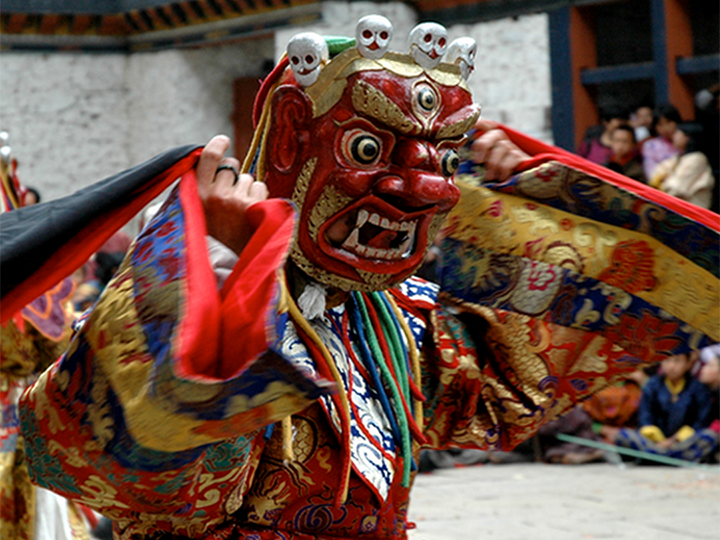
Following these three days, another dance ceremony called the Thimphu Tshechu followed. The Tshechu is a great annual festival in which monastic and lay religious dances are performed. Tshechu are performed throughout Bhutan in a generally similar structure at the Dzong in each region. Virtually every local citizen attends the Tshechu, attired in their finest clothes, and bringing the children and elderly. It is very crowded, though well-controlled, and amounts to a kind of national party: eating, visiting, and taking a day off with the family in the majestic stone courtyard of the Dzong, as ceremonial and spectacular religious dances play out all day long.
The Tshechu is characterized by the inclusion of a set of masked dance morality plays, originally created as a lay expression of spiritual values. The combining of monastic and lay religious dances in a single monastery festival is unique to Bhutan, among cultures practicing Tantric Buddhism. These lay dances comprise the bulk of dances performed at Tshechu. These were performed by dancers from the Royal Academy of Performing Arts, not monks, in a new Tshechu role for them originally and historically performed by locals. The RAPA dancers also performed a variety of folk dances from various regions in the country. Atsara, or jester-like characters, are always present during the Tshechu, keeping the momentum of entertainment before the crowd, adding bawdy humor, and serving as disguised dance masters. In this last role they guide the RAPA dancers should steps be forgotten, or they shepard a sequence difficult to do correctly while staying together as a group, doing so as a vulgar mockery of the dance.
We sat among the people, having no privileged position for camera work or even note taking, both of which became quite impossible in the throng. Using a SONY Cybershot P12 - a small camera remarkably shooting still and video picture on memory, not tape, - we tested the parameters of scale in photography as well as tested the ability to capture movement on film in this setting. The Cybershot P12 together with a Mac G4 laptop proved to be excellent research tools.
A total of three days outside of dance observation in Thimpu was spent traveling for brief stops in the regions of Punaka, Wangdi, Paro and Ha. Visiting the respective Dzong in each region provided knowledge of architecture for dance, local myths and stories, and an opportunity to see more art. The Wangdi Tshechu was taking place at the Wangdi Dzong when we arrived, and we watched a well-known farce being played out in that courtyard. In addition to the several Dzong, two other buildings stood out: a temple, Chime Lhakhang at Lobeysa between Thimphu and Punaka, home to divination and associated with a beloved eccentric saint, Drukpa Kunley; and The Iron Bridge Builder's Stupa in Paro, a remarkable 4-story stupa entirely painted with scenes, including important dance depictions, on the interior walls of each level. A visit to the National Museum in Paro emphasized the need for art conservation as well as the fact that, like the dances being in their original environment carrying out their original purpose, so too the art in Bhutan is almost entirely 'in situ', the museum being a rarity not a norm for the viewing of art. We concluded our architectural expeditions by trekking to the extraordinary temple Taksang, the Tiger's Lair, dedicated to the arrival in western Bhutan of Guru Rinpoche, flying on the back of a tiger.
We returned via Delhi, where our stay both coming and going was delightfully arranged by our collaborator Rupin Dang of Wilderness Films India, a Himalayan wilderness specialty production company. Rupin has offered his company as an Asian base for Core of Culture, and provided much insight into production issues we will face in Bhutan. We could not hope for a higher quality or more informed and sensitive collaborator. En route to Bhutan, we met with WFI in their offices and had a lengthy and productive conversation, learning more about each other's work, and discussing future possibilities.
There is much work to be done to make a catalogue of dances in Bhutan, as quite little information exists in distributable form: written or photographed or videotaped. Only the most skeletal list of major dance events has been compiled, and that for use by tour guides. While there is a Minister of Masked Dance in Bhutan, no comprehensive accounting of the dances in the Kingdom exists at the national level. Creating this list of dance events and their performance dates needs to be carried out by learning locally in each region of Bhutan, working through the various Dzong and astrological calendar-makers, what dances exist and when they are performed. Collecting and compiling that information is rudimentary for any documentation or analysis, and would be a meaningful gift to the Government, as well as an important contribution to scholarship.
A single book translated into English about the masked lay dance-dramas exists, "The Origin and Description of Bhutanese Mask Dances" by Dasho Sithel Dorji, former Director of the Royal Academy of Performing Arts. It is a welcome introduction to these dances where none was before. The translation suffers from lack of clarity regarding the separation of dance plots, dance steps, and dance sequences, and its editing would be a contribution for the next printing. One dance technique demonstration concept for video documentation based on Dorji's book would be to show the steps and sequences he isolates and identifies in his book. This would make our work a direct extension of his, acknowledging, honoring and building upon the local efforts.
Video documentation will be challenging for many reasons, and the successful filming of the dances - even from a production viewpoint alone - will be a significant accomplishment. The scale of Dzong architecture, and beyond that, the scale of the natural environment, is overwhelming and vast. This factor influences how the dances are performed, and is part of their genesis and character. Filming dances performed other than in a Dzong, such as dances performed in villages throughout Bhutan, mandates working off-road, through the wilderness, without a car, and devising a production strategy that suits such conditions. Here, the expertise and experience of Wilderness Films India, is invaluable.
The Royal Academy of Performing Arts is a professional organization evolved from the former Royal Dancers of Bhutan, who were then an adjunct to the King's court.
Its purpose and mission are situated in a bureaucratic, and not always danceinformed position within the policies and practices of the collected national organizations. This is fraught with every danger of dance evolution from the homogenization of dances, to the lack of oversight in performing excellence, to responding to an international need to show the dances, to dealing with ignorant forces seeing the employment of dancers, particularly women, as little more than transferable pleasure workers, trading in physical beauty for its own sake.
In Bhutan, as elsewhere in the Himalaya, didactic method for dance is a new concept made necessary by the endangered condition of living transmissions and the dearth of material about the dance. The dances currently performed by RAPA in Thimphu, and taught by RAPA in 4 of 20 districts, have their origins in the performances of local lay people in each village. It was to locals that the revealed "Treasure Dances" were intended and taught. So being, it is imperative for us to witness and document these dances where they are still performed by local believers.
Monastic dancing, called Cham, is separate from RAPA, and no book about it exists for public consumption. Cham is not a drama with a plot, and is more properly dance than the lay mask dances, which are more correctly identified as morality plays with dance in them: early dance-drama intended for illiterate people. Cham is more subtle, mystical, abstract, technical and secretive. Bhutanese monks retain ritual dance ceremonies more exclusively than other monks in the Himalaya, who have over time, increasingly made their dances public. Unquestionably, Cham is the most sophisticated dance form in Bhutan, and it deserves in-depth documentation as a technique of movement designed for mystical attainment.
Cham in Bhutan is performed in a manner categorically different from Cham in Ladakh, which sits at the opposite end of the Himalayan range. The genesis of physical movement within the body is different, and it results in a different effect upon the aesthetics, the observers, and no doubt in the dancing monks themselves. These defining peculiarities of Cham throughout the Himalaya need to be explored and understood. Understanding Cham as one part of a monk's mystical training suggests that variations within Cham may reflect variations in metaphysical emphasis and instruction within the various sects of Tantric Buddhism. This too needs explication.
The symbiotic relationship between dance and art in Bhutan is based in the practice of Tantric Buddhism. Beyond the basic approach of this project being art conservation paralleled with dance preservation, art and dance are joined in iconography, ritual and meditation practice. Most obviously, the dance masks themselves, and the deities and characters they depict are a common ground for both art and dance. The predominance in painting of gestural meaning and the religious significance of the posed body also unites them.
Literal depictions of dancing in art provide concrete connections. These include among the most profound scenes expressing tenets and beliefs of Tantric Buddhism. Within the Iron Bridge Builder's Stupa in Paro are murals depicting the 'Copper Colored Mountains of Padmasambhava's Paradise' inhabited by, among others, heroes and dakini, or sky-dancers. It was a vision of these characters dancing to the Bhutanese saint and "Treasure Revealer" Pema Lingpa in the 15thc, which became actual mask dances taught by him, and added to the canon of sacred dances. Of great interest is the fact that these Treasure Dances, unlike other revealed Treasure Dances where Dharmapala (former enemies of Buddhism turned protector deities) are depicted, have a basic movement idiom different from Cham and the existing dances.
It would be worthwhile to identify what Treasure Dances exist, and describe their characteristics within a context of historical dance. One spectacular lay mask dance, Raksha Mangcham, is purported to be a Treasure Dance revealed in the 4thc, making it among the very oldest dances dated in Himalayan Buddhism. In any case, art and dance both have a tradition of being revealed in visions and dreams of mystics.
Also in the 3rd floor of the Stupa, painted on a large cylinder running vertically through all 4 floors, is a depiction of Bardo, or the after-death state of consciousness, depicted here traditionally: animal-deities and animal-headed beings dancing to express and enact the process of leaving the phenomenological ground of being after death: when one's skin is literally shed. Bardo is often and variously depicted in Himalayan Buddhist art, sometimes with the creatures carrying out what appear to be quite specific rites, but here in a uniform way, donning or bursting out of human skin. It is intriguing what relation the depicted movements in Bardo scenes may retain to actual pre-Buddhist dances, and more readily, why dancing is always the way this state of being is depicted in art. Influences and references to animal-identification, cannibalism and the former practices of unconverted societies suggest themselves, as they indicate what role both art and dance had in early conversion. Both contributed importantly to the absorption and transformation of local custom into Buddhist practice, and provided mediums capable of embracing this doubly-enriched and refined repository of beliefs. Many dances, monastic and secular, depict deities and beings encountered in the Bardo state.
Bhutan possesses dances as part of traditional sports such as archery; unique and dying out wrestling and wristlocking techniques. Ceremony and movement protocol of the Royal Family, such as the Queens matching their attendance to the appearance of the Protector Goddess, has unique expression in Bhutan; and agricultural rituals and dances continue especially in more remote regions. All these examples of traditional movement combine with monastic and lay dances to describe a movement ecology and continuum unmatched in the Himalaya today. No catalogue or analyses of endangered movement would be complete or accurate without including all the elements sustaining and defining the whole. It is precisely those elements which for reasons historical or cultural do not exist elsewhere, that new understandings of ancient dance can be developed.
Such a comprehensive and coupled ancient dance project as this has never been proposed or carried out. The opportunity to undertake this in so rare and so potentially illuminating a place as the Kingdom of Bhutan is historical, and the fullest and finest commitment possible should be brought to the service of preparing this gift to Bhutan and the world. It will not be an easy or simple task, but certainly possible and rewarding. Further, the stature and exposure provided to dance by
being part of a traveling world-class art exhibition is an opportunity to introduce new thinking and awareness about the reality of ancient dance in our world. In this, Bhutan offers a great gift of enlightenment.
Joseph Houseal
Executive Director
Core of Culture
Dance Preservation
November 4, 2003
Chicago
| Internet presence, production and hosting Copyright © 1997-2003 theWebster All Rights Reserved Baldwin City, KS 66006 |