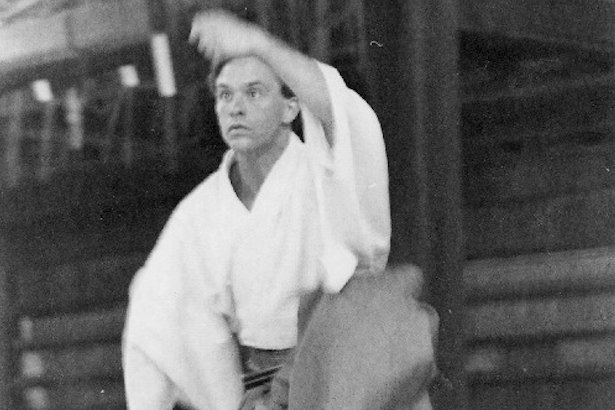
Merce Cunningham in Changeling, 1958. Image courtesy of the Merce Cunningham Trust and the Jerome Robbins Dance Division of the New York Public Library
My backstory with Merce Cunningham
I was fortunate to meet the world-famous modern dance choreographer Merce Cunningham (b. 1919), in Kyoto in 1988, and to spend an entire day together among the beautiful shrines and temples of Higashiyama, the eastern hills of Kyoto. We remained friends and kept up an occasional correspondence with written letters, until his death in 2009. I saw and spoke with him several weeks before his death, and we reminisced about our happy time together in Kyoto.
It so happened in 1988 that I was living in Kyoto and working as artistic director of Parnassus Dancetheatre, a company I founded with expert dance artists from traditions East and West. We’d been preparing our debut show, Mid-Hell Smoke, an English Noh play by poet Michael Fournier, based on a scene from Dante’s Inferno. After a year’s work, we’d used all our available funds and secured an excellent theater, the Kyoto Geijitsu Bunka Kaikan, for the opening night of a three-night run, hoping to entice and invite the dance audience of the Kyoto and Osaka area. Three weeks before our debut, posters appeared all over Kyoto: “Merce Cunningham Dance Company in Kyoto, One Night Only!” Guess which night? Yes, the same date as our debut performance.
So, I wrote a tongue-in-cheek letter to Merce in New York City, asking, “How far does a choreographer have to be from New York City to get a chance to show their work without being overshadowed by one of the Greats?” To my astonishment, Merce wrote back with a beautiful and witty three-page letter, saying if he could, he’d change the date. He asked if we could please spend a day together in Kyoto, enjoying the sites related to Zen and Noh, in which he had a keen interest. I was delighted and agreed in the letter that I mailed back to him.
When the day came, I met Merce at his hotel. He was beaming and friendly, and obviously arthritic. He walked without a cane, but with some difficulty. He wanted to walk in places where you could only walk—no cars, no bikes. I asked him what he wanted to see? He answered, “Nothing. Isn’t that what Japan is famous for?” So, we went to a rock garden with no rocks and to a Shinto Shrine on the top of Yoshida Mountain, where stood an outdoor Noh stage, more than 500 years old. It was there I performed a Noh dance for Merce Cunningham.
Performing a Noh dance for Merce Cunningham
On that fateful day in Kyoto, 1988, when I met Merce Cunningham and spent the day with him, he made it clear he not only wanted to see a Noh dance but knowing that I was studying Noh with a great master, Udaka Michishige, he wanted to see me perform a Noh dance. So I packed a Noh folding fan, the only prop needed for a basic dance, and carried it with me as we went through our day.
When I noticed that he walked with some difficulty, I offered to modify the plans. My intention, after visiting Zen and Shinto gardens, was to ascend to the top of Mount Yoshida, a small mountain within Kyoto itself offering splendid views. At the top, after passing through 100 vermillion gates that adorned a cobbled path, was the hushed Munetada Shrine, an ancient Shinto shrine with a simple raked gravel garden and, remarkably, an archaic outdoor Noh stage on the pinnacle of the peak. The priests knew me well as my home was nearby, and they allowed me to practice on the stage. I was always impeccably respectful. In any case, I’d hoped to take Merce there and perform a Noh dance for him. He thought it was a great idea, and the ascent and performance were the core of our day together.
Walking with care, our slow hike uphill became a pilgrimage, as sunlight darted through the many orange-red gates. Ascending through all the gates was performance art in itself, a transformed walkway of shimmering light, in which we talked about Noh, moving from the belly (Jp: tanden), floating by sliding, and painting with energy.
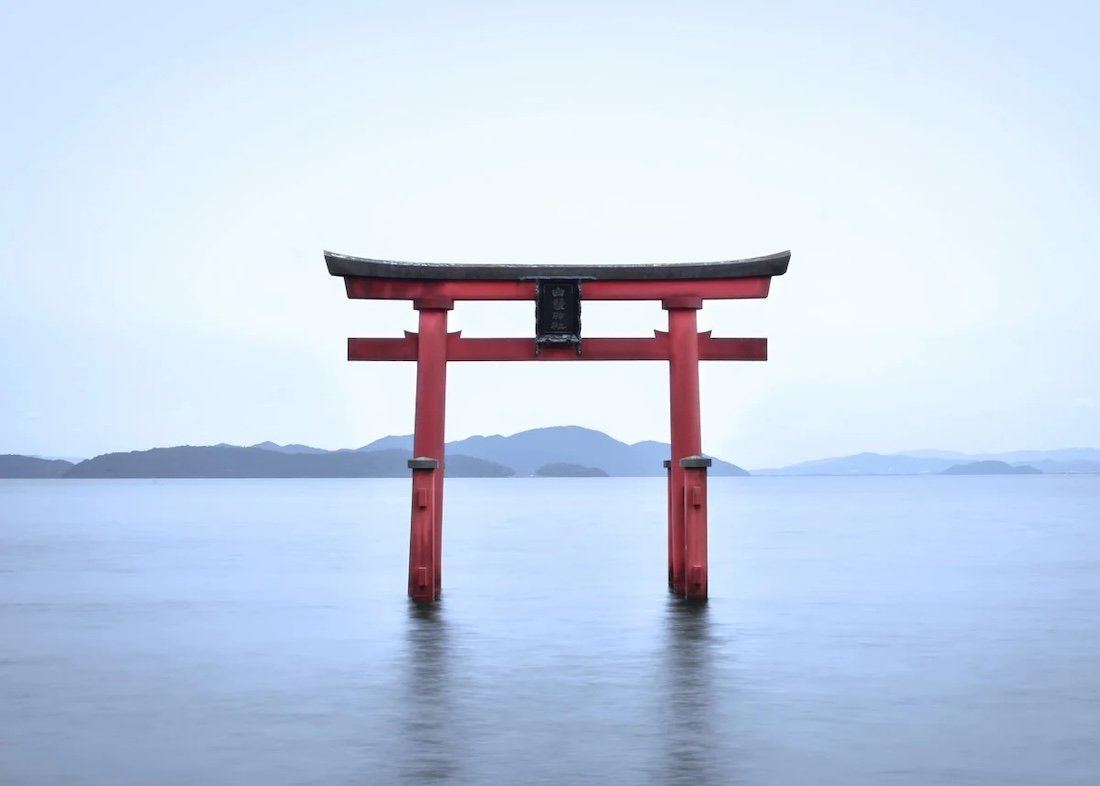
Vermillion torii gates ascending a mountain. Image courtesy Core of Culture
Once we arrived, Merce took a seat on the stairs of the mountain shrine, as I explained that I would dance Kokaji, about a sword-smith and the Fox god Inari, who comes to assist him in making a sword of divine protection. I was a bit concerned—not that Merce would be unable to take in the dance, but concerned because Noh, in all its inner and outer techniques, is very slow form of movement, too slow for most people. I took out my Noh fan, did the preliminary chanting, and went on to perform a 10-minute dance atop the lovely old Noh stage among the pine trees for an audience of one. I knew he was observing it carefully, taking in everything.
My performance was slow and dignified. I did a fine Noh dance for Merce. When I finished, he said, “I thought it seemed fast?” I explained that I was not wearing an inhibiting mask or large costume, and that I was probably a bit nervous, and that this ancient stage is in fact a bit smaller than a standard Noh stage today. He understood.
Then he asked me, “Would you do it again for me? Three times slower?” And so, I did. The 10-minute dance dilated into a 30-minute shared dance experience with Merce Cunningham, as we together explored the form and energy in a most quiet, intense, open, intimate, artistic way. He was sage. He was friendly. Just as the audience at a Noh play is essential to its moments of meaning and insight, so Merce was completely a part of my performance, the object of his concentration. When the dance was over, half an hour later, neither of us said anything.
Joseph Houseal performing Kokaji on the Gion Shrine Noh stage, 1986. Image courtesy Core of Culture
This article is an excerpt from Buddhist Dances, Movement & Mind, by Joseph Houseal, Motilal Banarsidass, 2025.
See more
Core of Culture
Related features from BDG
Ma: The Art of Empty SpaceMatsukaze: Wind in the PinesThe Ancient Noh Stages of Sado, the Isle of ExileNoh NowPure Land Buddhism in Noh: The Shuramono Plays of ZeamiBeauty and Sadness: Reflections on a Japanese Noh Play
More from Ancient Dances by Joseph Houseal
The post Performing a Noh Dance for Merce Cunningham appeared first on Buddhistdoor Global.
Itsukushima Shrine Gate, Miyajima Island, Japan. From miyajima.or.jp
“Ma,” the Japanese concept of “space,” is much more than mere physical distance. It’s a nuanced and multifaceted idea that profoundly influences various cultural disciplines in Japan, shaping aesthetics, the sense of time, communication and expectation, even social interactions. When the late singer David Bowie saw—and heard—a Japanese Noh play for the first time, he couldn’t quite sense the rhythms of the music. He called it “variable time flow” and “found rhythm.” After asking the musicians what the rhythm was, they told him it was in eight counts, Bowie looked puzzled. Then they told him, “It’s eight counts . . . with holes in it.” The holes in the rhythm, stretching out the silences between drum strikes, creating distended and dilated theatrical moments, are ma. Emptiness at work, creating an open gateway to embracing deeper thinking and personal experience for the performer and the audience alike.
Zen meditation rock garden, Kyoto. Image from Core of Culture
Ma is an ordinary word too. Anyone familiar with the London Underground will know the common announcement when a subway car stops at a station: “MIND THE GAP between the train and the platform.” The gap is ma: space, interval, active emptiness. The Japanese aesthetic term ma often refers to the intentional creation of space or emptiness as an active element in artistic performance and audience perception. A Shinto shrine in Japan, very much like a Noh stage, is little more than framed space. A Noh stage is essentially an empty cube, elevated and roofed. What is sacred at a Shinto shrine is the space, not the wooden beams. In a Zen rock garden, considered an expression of Buddhist philosophy and aesthetics, the stones are placed to create ma, space, into which the meditating observer can pour their own mind and spirit, traversing transcendent realms of inner meaning by means of the activated ma—emptiness, nothing-ness—as a tool and technique of consciousness cultivation. Pure gestalt: ma within ma, encountering ma; emptiness flowing and stillness active.
Nashiki Shrine, Japan, looking from the shrine stage toward inner shrine. Image courtesy of the author
Ma connects deeply to notions of minimalism and the artistic function of clean lines, whether in architecture or performing arts such as Japanese Noh. There is no real “set” on a Noh stage, rather the main performer, in an elaborate costume and wearing a mask, is the locus and focus: the moving center of the whole. A pine tree, representing the site of the earliest Noh plays, is painted on the back wall. The stage is essentially a box of empty space, filled not only by the physical actor but with vital space, volume, energy, atmosphere, and nothing but the spiritual reality of the main character. And so, the space of a Noh stage is full of memory, poetry, spiritual crisis, and the openness of the aesthetics of emptiness. This allows the perceptions and sensations of the audience to join the performers in the emptiness out of which a Noh play arises, which in fact is intended to be that same emptiness at the core of being—the same emptiness experienced by a Zen monk in meditation or a miko, a Shinto priestess, tracing the abstract patterns of her accumulated spiritual possession.
Noh play Izutsu, from Arthur Waley, The Noh Plays of Japan, 1922, Alfred A. Knopf, New York. Image courtesy of the author
In the Noh play, Izutsu, the ghost of a lover of the poet Narihira, wearing his clothes, peers into a well where they met as children. The decrepit well is a mirror of memories, heartbreak, and madness. Alone in the empty space of a Noh stage, the actor looks into an empty, framed space, and the climax of the drama is emptiness upon emptiness, the very nature of reality. There is space for the audience to participate in the creation of meaning. Ma—the empty space, its framing, and its artistic manipulation create the dynamic interplay of flow and stillness, enabling fluid transitions into non-material dimensions of existence. Physical, rhythmic, and aural space are the essence of Noh performance and of Shinto Miko Mai dances. The dancer glides, turns, and pauses, allowing the empty spaces to become integral parts of the choreography. These pauses aren’t mere breaks or stops. Rather, they are empowered energetic emanations created to amplify the grace and precision of the movements, inviting contemplation and connection with deities, characters, and inner realities.
Ma becomes a canvas for interpretation. The late ballet dancer Rudolph Nureyev observed: “If you want to make something more beautiful, do it more slowly.” This aptly describes Japanese Noh’s very slow manner of performing, featuring its beauty. Instead of becoming boring, the slowness highlights the figure in space, trance-like, inviting the audience into a calm, concentrated artistic experience.
This manner of highlighting movement, slowly, in empty space is a universal quality of ma applied to performing arts. Please enjoy here a remarkable short film from the National Ballet of Canada, featuring choreographer-dancer Guillaume Côte, and the cinematography of Jeremy Benning. Emptiness and slowness are used to great effect, finally opening to a new and different emptiness; a quantum flow of open spaces, not negative spaces, defined by the dancer in the dimension of nothing. Dance itself is rarely so well displayed.
Lost in Motion, directed by Ben Shrinian, choreography and dancing by Guillaum Cǒte, director of photography Jeremy Benning. Image courtesy of the National Ballet of Canada
See more
Core of Culture
Related features from BDG
Matsukaze: Wind in the PinesThe Ancient Noh Stages of Sado, the Isle of ExileNoh NowPure Land Buddhism in Noh: The Shuramono Plays of ZeamiBeauty and Sadness: Reflections on a Japanese Noh Play
More from Ancient Dances by Joseph Houseal
The post <i>Ma</i>: The Art of Empty Space appeared first on Buddhistdoor Global.
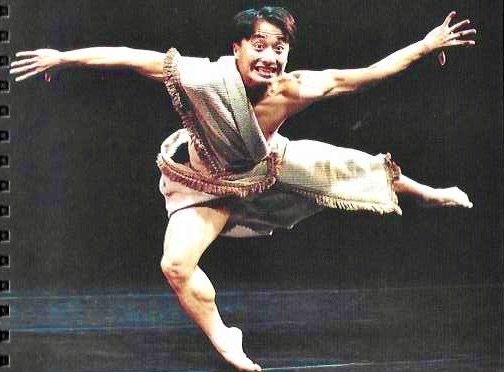
Vast Desert, Solitary Smoke Rises Straight by Liu Feng Shueh, 2000, Taipei. Image courtesy of the Neo-Classic Dance Company
The oracle bone script (甲骨文) is the earliest attested form of Chinese writing, dated to the Late Shang dynasty in the second millennium BCE. The inscriptions were carved on the underside of turtle and tortoise shells called plastrons, or on ox scapulae as part of divination rituals that were a kind of scapulimancy or blade-bone reading. After heating, the cracks were “read” and divined. The inscriptions recorded both the query and the diviner’s interpretation. These ritual objects of divination, collected, are known in China as oracle bones. As such, the oracle bone script is one of the earliest known forms of written language, a ritual use for language, where an image—a pictograph of a person dancing—is language itself. We see a dancer holding feathers or branches in a ritual to communicate with the divine: another dimension of reality. There is a shamanic aspect to this glyph.
The oracle bone script for dance. Image courtesy of the author
The petroglyph that forms the basis for the Core of Culture logo is Indian and, much older than any written script, nevertheless uses dancers as drawn language. In the oracle bone script for dance, the evolution from picture drawing to abstract use as language-symbol is evident. How fascinating that at this earliest phase of language-making, the very image of the body dancing in a ritual is present, bringing notions of mental transformation and the sacredness of dance as a communicating medium.
Petroglyph, Chalcolithic period, Central India. Image from Newberry Library Cartography Collection. This glyph is the basis for the Core of Culture logo
Over time, those pictographic forms developed into bronze script, seal script, clerical and regular script, and so on. Many oracle characters began as pictographs or simple ideographs, but by the Late Shang period they had already become partially conventionalized and abbreviated into use as written characters. So when we talk in artistic terms about an “oracle-bone form” of dance, we are often reconstructing from variant graphs found in excavated bones, on bronzes, and in early manuscripts. Today there is a calligraphy style called “Oracle Bone.”
Actual oracle bone from the late Shang dynasty, with script. From wikimedia.org
Doctoral work conducted by the late Taiwanese choreographer-scholar Liu Feng Shueh (1925–2023) in London at the Laban Centre for Movement and Dance, and at Cambridge University, examined the frequency and contextual range of the oracle bone script for dance, and its significance as a marker of the magical profundity of communication at ever-deeper levels of existence. This is similar to the Newar Buddhist understanding in Kathmandu, where the word dance means meditation. What is so valuable that it is to be divined, to be interpreted, to be inscribed, and recorded as words? What action is this? It is the divine action of expression at the core of one’s essence; one’s purpose and action in the world.
Mme. Liu Feng Shueh with the author, in Taipei. 2012. Photo by Gerard Houghton for Core of Culture
I was fortunate to know Mme. Liu Feng Shueh from my own studies at the Laban Centre of Movement and Dance, to read her thesis, and to see her choreographies performed. I was shown many reconstructions from the Tang dynasty in her studio theater in Taipei, and also even earlier Confucian dances, noble and geomantic. Madame Liu believed that the rigor and nobility of Chinese dance emanate from the oracle bone script for dance. Without the truth of the meaning of the glyph being alive in a danced performance, something critical is missing. Whether modern dance, the dances of Taiwanese indigenous people, or bringing to new life the dances of archaic times, Liu Feng Shueh taught and created a connection to the oldest expression of dance. She is considered one of the pioneers of Chinese modern dance.
Liquid Ambar by Liu Feng Shueh, a Tang dynasty dance reconstruction. Image courtesy of the author
What a delight to see recently for sale a most unusual scroll, dating probably to the 1970s. I purchased it and it hangs in my study. It is in the standard literary form of four characters. Modern script and the artist’s Buddhist name appear smaller on the left side. The scroll is as much poetic and philosophical as it is rhetorical and imagistic. It is meant to hold much meaning, beyond words, elusive and poetic. It evokes the spirit and time the Oracle Bone period, and in that, it carries a ritual weight, a seriousness of action. This modern calligraphic scroll written in oracle-bone script declares: Dance is the complete practice.
What at first looks archaic, paleographic, and indecipherable becomes a living statement of ritual, spirituality, and art—reminding us that dance is not mere performance, but the fulfillment of wholeness; a practical way to become what Daoists call “a real human.” Dance is moving in more than one world at once, gracefully gamboling between them all, the consummate picture of self-awareness even as selflessness is the end state of the ritual dance. According to a 12th century Drikung Kagyu Buddhist dance treatise, The Snow Lion’s Attributes, “Dance is the apotheosis of mystical attainment.” This meaning is not far from the scroll we are examining.
Bone oracle dance scroll. Image courtesy of the author
This is my reading of the scroll, although there are others, as with any translation, and surely regarding any symbolic divinatory image. Oracle bone script was the language of ritual and communication with the divine. The emphasis of dance as the first character on this scroll and using the oldest known written glyph for dance underscores the spiritual sobriety and the awesome magical power of dance, summoned and extolled anew. Plain, powerful, unfancy. And a bit postmodern, relying on bold classical forms for a modern anachronistic effect.
This scroll was offered to me by an art dealer whom I know. What caught my attention immediately was the character for dance, written in oracle-bone script. I knew that glyph, with its raised arms and feathers, a remnant of the earliest ritual dances carved on turtle plastrons more than 3,000 years ago. I bought the scroll not knowing what the other characters meant, drawn only by the presence of dance in its archaic form.
The inscription turned out to be four characters: 舞之全業. At first glance one might translate this as, “All dance,” or, “The complete art of dance.” But in English that phrase sounds more like a survey—a book cataloguing styles and histories; or an introductory book for dance students. The scroll, however, is saying something very different. A more faithful and serious rendering would be: “Dance is the complete practice.” In other words, dance is not fragment, not entertainment, not even just art, but a wholeness—a practice that encompasses body, mind, offering, and discipline. The dance image used is that of a ritual dancer—the original purpose of dance.
The scroll is modern, written in a revivalist oracle-bone style by a calligrapher signing as Yiru (One Suchness), a pen name drawn from Buddhist thought. It is not a relic of antiquity but a personal creation, a high-minded, poetic, and mystical self-invention, placed in the great tradition of Chinese calligraphy. The brushstrokes themselves move like some ancient pace: bold, archaic, enigmatic, embodying the mystery of what they declare, while the artist’s anonymity is shrouded in a spiritual and poetic name. Ink painting and calligraphy are sometimes discussed as dance.
To Western readers, this idea is unusual. Dance is usually thought of as performance or entertainment, sometimes as art, but rarely as spiritual practice. In many Asian and ancient traditions, however, dance is never merely symbolic—it is effective and purposeful. Monks, wizards, and shamans danced to consecrate space, to invite deities, to protect the community, or to transmit teaching.
In Tibetan Buddhism, the great cham dances are not merely spectacles but ritual offerings. The dancers embody protective deities, and the steps themselves renew time and purify the environment. In Daoist ritual, meditation, and martial practice, the Pace of Yu is a sacred choreography taught to align the practitioner with cosmic order. In Japan, Zeami wrote of the dance in Noh as “writing calligraphy in the air,” a striking reminder that movement can be both art and experiential revelation. Across these traditions, dance was understood as complete practice: effective, transformative, and integral, embodying all aspects. Alive and so expressing life; elemental and so, universal.
Dance. Image courtesy of the author
Putting a foot forward, “of”. Image courtesy of the author
Person under a roof, wholeness. Image courtesy of the author
Rows of plants, cultivated practice, karma, vocation. Image courtesy of the author
The calligraphy on this scroll does not describe dance, it declares it. Dance is the complete practice—whole, capable of carrying body, mind, and spirit together. The character for dance itself shows this: hands holding feathers, feet in motion, a figure dancing in embodied ritual presence. When written in oracle script, the ancient meaning is visible again: dance as invocation, as communication with the unseen.
What is remarkable is the simplicity of the inscription. Four characters, written in an archaic style, yet carrying a truth that entire treatises struggle to express. This is in the spirit of the literati: to take brush and ink and make of them not only art but a way of living. The boldness here is in its clarity. It does not embellish or argue. It simply says: dance is the complete practice.
In this way the striking scroll is more than decoration. It is a living statement of ancient ethics and philosophy in our own time, a reminder that art can still be a vessel of truth. The calligraphy itself finds its flow, moving between ancient oracle script and a modern hand, holding a mystery while speaking clearly. It stands as a small but profound example of how artistic tradition and personal spirituality meet, how practice can be inscribed in the simplest of forms.
See more
Core of Culture
Related features from BDG
The AttanPadmasambhava’s Buddha-field of Tantric Dances: Re-establishing Dance in the Narrative of Guru RinpocheI Sing the Body Electric
More from Ancient Dances by Joseph Houseal
The post Dance Is the Complete Practice appeared first on Buddhistdoor Global.
Following is a transcript of the author’s address for Buddhistdoor Global’s 30th Anniversary Symposium in Vancouver, Canada, held on 3–4 September 2025.
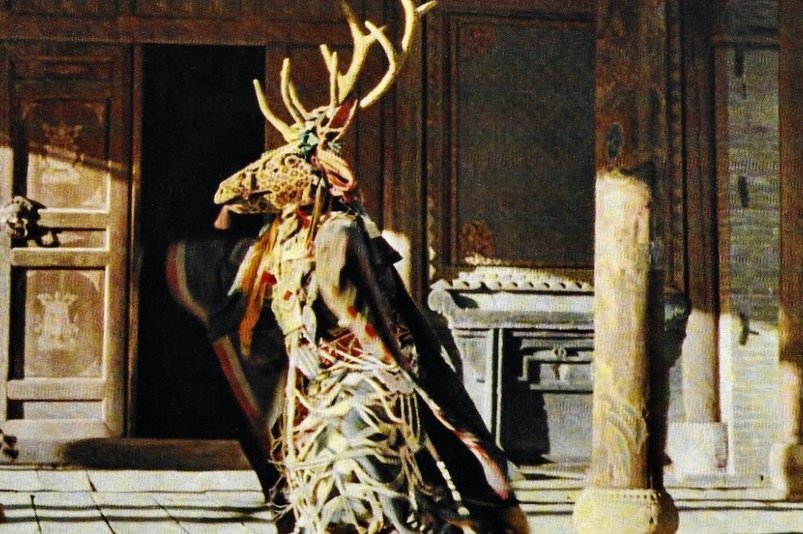
Stag dancer, tsam dance, Ulaan Baatar, 1967. Photo by Werner Forman. Used with permission from the Werner Forman Archive
This month marks the 10th anniversary of Ancient Dances, my monthly column for Buddhistdoor Global. I’ve never missed a month, always considering it an honor and an edifying discipline to produce this column for BDG. It has become a personal yoga. Through these 120 monthly essays, over a decade, my column has attracted a steady international readership. This is not because all the readers are dancers, although there are a solid number of dancers who read my work. It’s because people enjoy good writing about things that they don’t know, or never had a chance to explore.
I was a contributor to Ballet Review in New York, for 34 years. It featured excellent writers. Many subscribers did so because the writing was good, whether or not they had a passion for the dance. They had a desire for good writing. A fine arts journal in classic B5 size, Ballet Review ceased publishing in 2020, after 55 years. Those 34 years of quarterly accumulation contain some of my best writing. I have had similar good fortune with BDG: like with Ballet Review, I have a very good editor. I’m a team player. I bring the best I’ve got and allow it to speak a language of shared values. Journalism is a perilous enterprise and I admire the editorial and production teams at Buddhistdoor Global for continuing to bring forth good writing, provocative topics, and intelligent perspectives. I am grateful for the platform from which I advocate for endangered ancient dances and movement forms in the healing, meditation, and martial arts. Buddhist practices uphold much ancient knowledge; Buddhist dances are repositories of knowledge.
I view my professional life, working with dancers from all parts of the world, as a kind of social contract: because I am afforded the opportunity to work in a way not open to most, I have a responsibility to share my experiences, discoveries, and research with others, as much as to assist the practitioners with whom I work. I am here to uphold the art of dance and the community of dancers; as well as the practice of exploration and the community of explorers. Writing is a basic way I share my work and experiences. But in fact, it is as an artist that I experience most things, and it is my dance-based skills in producing, directing , rehearsing, and documenting that make me useful to practitioners of ancient dances who negotiate their own continuity as a way of life: a constant re-alignment with tradition and modernity, as generations pass, and generational knowledge reveals its repositories for a role in future generations, or not. Writing facilitates my usefulness as a dance professional.
In my earliest encounters with Tantric Buddhism, I was struck by the initiatory story of Guru Rinpoche subduing malevolent energies with a dance at Samye monastery, thereby establishing Tantric Buddhism in Tibet in the eighth century. I wondered ardently for years: “Why did Guru Rinpoche use dance as the first act of Tantric Buddhism in Tibet?” I asked many people, lamas, dancers, scholars. Finally, the Je Khenpo, patriarch of Buddhism in Bhutan, answered plainly to me, “Because people like dancing.” I agree. My column for BDG treats the subject of dance, in its broadest sense, and people like dance. Dance draws people in and demonstrates an order beyond a mundane reality, beyond words, a whole-body response and engagement. Buddhism has an amazing legacy of dances connected to mystical visions, as well as dance as an advanced tantric yoga. Buddhist dances are remarkably resilient, many lasting centuries without serious disruption, others evolving in ways that sustained the thread of dance. Buddhist dance is philosophy in motion, mental cultivation in action. My writing intends to invite people to see and know more about dance, connect it to their own lives, and be welcomed as they encounter new ideas and expressions in form. Buddhist dance is embodied metaphysical cosmology, and can be viewed in many different ways. I like to bring the practicalities of dance and dancers into the story.
A Chinese daoist diagram, instructing both the inner and outer visionary dance, Walking the Big Dipper. Image courtesy of Core of Culture.
Another reason this column has attracted readers is that people are keen to see how dance is a vehicle for Buddhist principles, and other driving creative forces. We have witnessed over more than 2,000 years, that dance succeeds in its malleability. Dance—this performed and embodied alchemy of person, being, shape, and inner disposition—exhibits endless variation, each exemplary, and usually, deeply human in endeavor. That is what I have tried to show in these essays—in particular, that creative artists of all ages have taken principles, cosmologies, techniques of mental cultivation, along with techniques of choreographic innovation, and created epochs of cultural importance. Driven by an essential intention toward the truth of danced expression of a transformed state of mind, ancient sacred dances reveal characteristics not found elsewhere. This is how Guru Rinpoche established a radically empowered dance—cham—as a central characteristic of Tibetan Buddhism in the eighth century, and also how the recently deceased avant-garde theater director, the visionary Robert Wilson, transformed what opera, dance, and theater could be in a tapestry of art forms each re-invigorated by an Eastern principle, often robed and adorned in light.
Robert Wilson’s avant-garde masterpiece, Einstein on the Beach, in 1976, was an “abstract opera” composed by Phillip Glass, also a Buddhist, and a practicing Jew, with interests in Daoism and Hinduism. This production, choreographed by Lucinda Childs, revolutionized theater internationally, and became a touchstone of the global avant-garde, ushering in what would become one of the great ages of international avant-garde performance.
Robert Wilson explained his aesthetic approach when producing a museum show of Chinese imperial masterpieces. “In order to see this work, we need to empty our heads. Get the daily life and activities out of our minds so we can focus on something else. John Cage had a great influence on my thinking. He was one of the Western people that brought us closer to Eastern ideas. After having read Cage’s book on silence, my life was forever changed.”
Einstein on the Beach, composed by Phillip Glass, choreographed by Lucinda Childs, and directed by Robert Wilson. Screenshot from the below video
In my column for Buddhistdoor Global, it is about the transformative power of Buddhist, Daoist, and Confucian ideals on each other, and as understood by groundbreaking dance artists who experimented with the application of Buddhist principles in their own work, and in their own lives. Antony Tudor, one of the greatest Ballet choreographers of the 20th century, lived as a practicing Zen Buddhist all his life, dying where he lived; at the first Zen Institute of America in New York, the Buddhist community to which he belonged. His epoch-making ballet Jardin aux lilas, (The Lilac Garden), was the world’s first “Zen ballet” by design. Maude Lloyd Gosling, the South African ballerina who debuted the lead role in this ballet in 1936, described her artistic goal as “expressing the Zen of unspoken heartbreak.”
Learning these astonishing facts and statements of artistry fuel my sense of exploration and discovery, because the application of spirit, self, and principle always creates something new, something worth noticing for the evolution it portends. A master artist can uplift this newness into transformations that impact art forms, dance forms, whole cultural epochs. Sharing compelling examples of artists and explorers, practitioners and dancers resonates over time and the mind’s eye. Each with profound individual understandings, the application of higher principles to their lives and art, results in something new, revitalizing the human spirit. Inviting people into ancient and esoteric dances and the states of being they engender will remain the purpose of this column, Ancient Dances, for more years to come. Thank you for reading my column.
See more
Core of Culture
Related features from BDG
Buddhistdoor View: Buddhistdoor as a Dharma-sharing Platform Three Decades on, and into the Future
Related news reports from BDG
The Door to Digital Dharma: The Age of AI meets Ancient Wisdom at BDG’s 30th Anniversary Symposium
More from Ancient Dances by Joseph Houseal
The post Ancient Dances Today appeared first on Buddhistdoor Global.
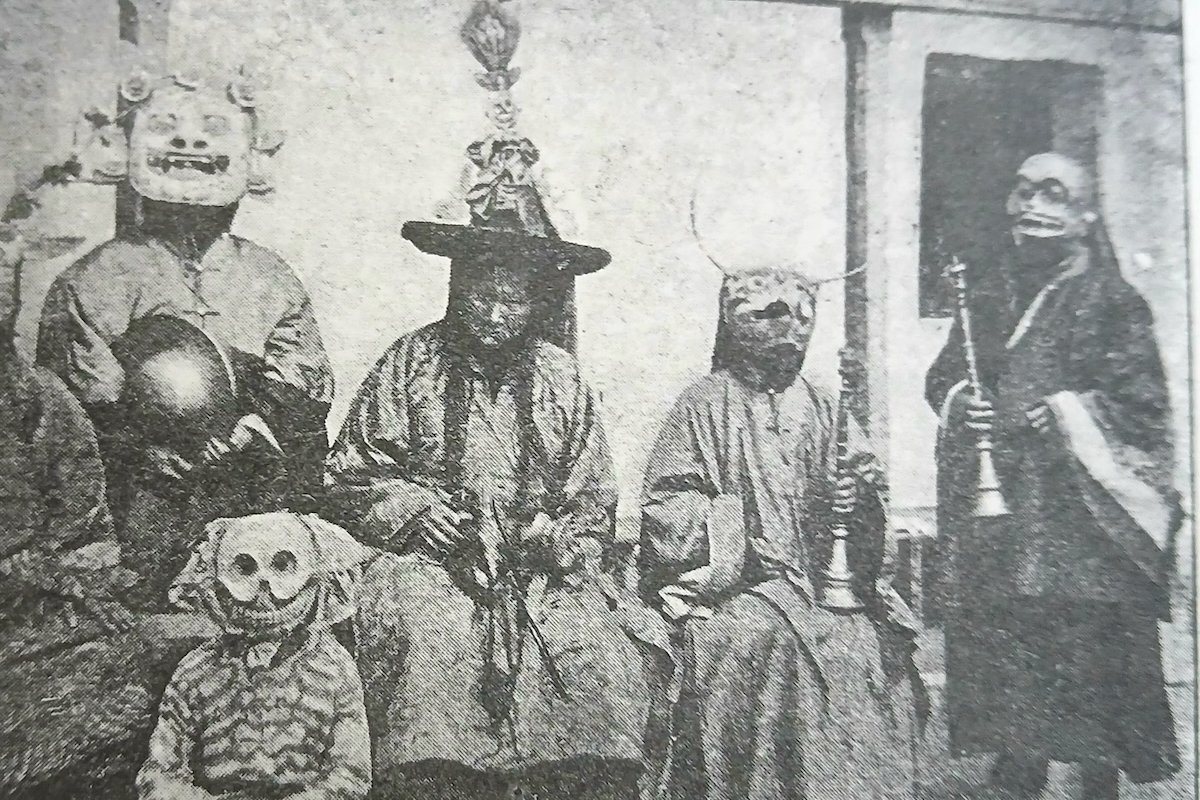
“Some actors in the mystic play,” from L. A. Wadell, Lamaism, 1895. Image courtesy of the author
The early explorers treated in this three-part article represent a wide range of expertise, from painting to linguistics, dance to cartography. The 15 explorers evoked here—Giuseppe Tucci, Sven Hedin, Alexandra David-Neel, Ted Shawn, Tyra Kleen, G. I. Gurdjieff, Beryl de Zoete, Arthur Waley, Rolf De Mare, Claire Holt, Ernest Fenollosa, Rene de Nebesky-Wojkowitz, Michael Aris, Lam Anagarika Govinda, and Nicholas Roerich—can be easily referenced in my previous article “Messengers of Mind, Cultural Explorers and the Encounter with Buddhism, Part One: A Gallery of Explorers,” which can also serve as a kind of glossary.
Ted Shawn in The Cosmic Dance of Shiva, Shiva Temple Mahabalipuram, India. 1926. Taken from Shawn The Dancer. J.M. Dent & Sons, London,1933. Image courtesy of the author
Among these, regarding dance, they fall into two groups: those who misrepresented it as ghoulish and pagan, and those who saw that dance was embodied consciousness: a gateway to knowledge, ritual, and meditative function, and a basis for cultural continuity. The early explorers included botanists, surveyors, military commanders, soldiers, doctors, and missionaries. There is much to learn from those who got it wrong. The best early descriptions of Buddhist cham dance come from L. A. Waddell, who condemned it entirely as “wanton mummery.” There is a British engraving of Hemis Monastery cham, in which nearly every aspect of the dance is incorrect. I gave it to the Hemis Monastery Museum, where it now hangs.
Engraving of the Hemis Monastery cham festival, produced from a pencil drawing of the live event. England, 19th century. Artist of the Younghusband campaign in Ladakh, c. 1889. Nearly every aspect of the dance is incorrectly recorded; that the cham is circular is correct
It is a bit of a thrill, therefore, to encounter an early explorer who not only got it right, but asked provocative questions about the nature of dance as depicted in ritual Buddhist paintings. Giuseppe Tucci saw the dance as essential to understanding Tantric Buddhist art and the deities and characters depicted. Not only does he point out that a class of dakinis dance with wrathful deities, but he goes to lengths to describe and define the rarified nature of the creatures who are dancing. It explains, in part, the role of dance in meditation techniques to know exactly who the dancing beings are in a meditation; and when, in the process of meditating, they appear.
Protector of the Dharmakaya, 17th century, Tsaparang, Tibet. From Tucci, Indo-Tibetica lll.2, Reale Accademia d’Italia, 1935. Rome. Plate IV. Image courtesy of the author
Cartographer and explorer Sven Hedin was also a skillful painter and draftsman. In high contrast to the fantastical demons of the British etching, above, Hedin produced excellent renderings of the costume and movements of cham dance, genuine documentations of choreography, mudra, and mask
Cham dancer, pencil drawing, Sven Hedin. Image courtesy of the Sven Hedin Foundation.
Ted Shawn documented, on film and in photographs, Tibetan Buddhist cham dances in Darjeeling in 1926. In his book Gods Who Dance—which accompanied his two years of documentations in 1925 and 1926, providing an unprecedented baseline of ancient Asian dance—Shawn wrote insightfully about dance in Buddhism: “It is an ironic fact that there is more actual dance connected with Buddhism itself than almost any other religion . . . Buddhism did not destroy or supplant the religion of the people previous to its coming, but it adjusted itself and fitted in with the gods that were already worshipped. Perhaps this explains it? For in Burma, Ceylon, and Tibet, three of the countries for which Buddhism is the official religion of the country and where it is most powerful, I have seen dancing in connection with Buddhist temples and Buddhist religious festivals. This then means that the primitive people of Tibet, of Burma, and of Ceylon, had gods who danced, and that Buddhism slowly absorbed both the gods and the dancing, rejecting neither the one nor the other.”
Shawn’s influence on early modern dancers was tremendous, counting Martha Graham, Charles Wiedman and Doris Humphrey as his students.
Nicholas Roerich, the celebrated painter and researcher of initiate dance traditions, also influenced Western dance in the early 20th century. Drawing on his years of explorations in Asia and Siberia, Roerich created the scenario, sets, and costumes for Le Sacre du Printemps (The Rite of Spring) composed by Igor Stravinsky and choreographed by Vaslav Nijinsky. Sacre is considered one of the most important creations in 20th century dance and music, utterly transforming the notions of what dance and music could do.
Le Sacre Du Printemps, 1913. Scenario, set, and costumes by Nicolas Roerich. Choreography by Vaslav Nijinsky. Music by Igor Stravinsky. Image courtesy of the Dance Division, New York Public Library
These two early explorers, Shawn and Roerich, inspired by their researches into Asian sacred dances, through their direct influence helped to cultivate and raise up Matha Graham and Vaslav Nijinsky, two of the most significant pioneers of 20th century dance invention. The art of dance has its own transmissions, not comparably initiate, but fundamentally driven by an understanding derived from ancient dances: that dance is an enactment and embodiment of spiritual and emotional realities, not merely a representation or performance of it. These are profound insights into the nature of dance itself.
Writer Beryl de Zoete, working in India and Indonesia, and anthropologist Claire Holt, who worked in Java and Bali and the Indonesian islands, recognized dance as a form of knowing, and a means of transmitting spiritual and cosmological truths. De Zoete saw that gesture, rhythm, and spatial structures mirrored metaphysical systems. She understood the dances as living ritual texts, “the body as scripture.” Holt, more concretely, argued that dance was an historical archive in motion, capable of preserving mythic narrative, political ideologies, and religious worldviews, long after texts and historical figures were gone.
Tyra Kleen’s astonishing art nouveau illustrations documenting the mudra, or ritual hand movements, of priests in Bali and Java, were inspired in part by her observation that the continuity of sustained importance of dance within Balinese society was itself a form of resistance against colonizing powers. Her remarkably exact and accurate documentations of mudra were exhibited at the Victoria & Albert Museum in London, recognized for their scientific value as well as their almost subversive arch style.
Four distinct mudras, by Tyra Kleen for Mudras, The Ritual Hand-poses of the Buddha Priests and Shiva Priests of Bali (1924). From Core of Culture
Lam Govinda writes about tantric ritual and visualization, addressing the double techniques of inner meditation and outer bodily form: that the inner mudra and outer movement create an essential alignment of subtle and gross energies. Gurdjieff, who established his own set of dances for his followers, based their construction on ancient sacred dance prototypes that he studied in Central Asia and the Middle East. He was not trying to portray metaphysical ideas, rather seeking to invoke and embody inner transformation through precise movement and breath control. He taught that gesture, posture, and rhythm could reshape consciousness. The dances are still performed today, and although they can appear unusual and counterintuitive, their continued use as a form of mental cultivation is noteworthy. He taught: “What you cannot discover in your own body, you will not discover in any place in the world.”
Gurdjieff dances. From Gurdjieff-dances.com
In a remarkable example of modern sacred dance traditions grafting, transplanting, and transmitting through one another, the leader of the Gurdjieff Community of Conway, Massachusetts, Paul Anderson, handed over the site and the followers of Gurdjieff’s Fourth Way there, to Dzogchen teacher Namkhai Norbu, who consequently established his own Vajra dances on the same spot, with the Gurdjieff students becoming Vajrayana Buddhist students under Namkhai Norbu. There are still dancers alive today whose spiritual practice includes both the movements of Gurdjieff dances, as well as the Vajra dances of Namkhai Norbu.
These insights into dance by early explorers are connected in the awareness that Asia’s ancient sacred dances, including Buddhist dances, are ontological: they deal with the essence of being itself and how it emerges. Dance does something to the self and to the world; things are produced and transformed by it. Dance is an agent of mental cultivation and spiritual liberation. Dance changes the experience of inner reality. Where early explorers encountered these realizations and characteristics of sacred dance, we now have dancers and dance researchers enriched by these concepts who find a new recognition today in the practices of embodied, authentic, and somatic movement. In fact, it is often dancers focusing on authentic movement in contemporary practice who most relate and connect with the consciousness-altering dances of Buddhism and their embodied explorations of inner reality.
See more
Core of Culture
Related features from BDG
Messengers of Mind, Cultural Explorers and the Encounter with Buddhism, Part One: A Gallery of ExplorersMessengers of Mind, Part Two: Liminal Lives
More from Ancient Dances by Joseph Houseal
The post Early Explorers and Their Encounter with Buddhism, Part Three: Dance Insight appeared first on Buddhistdoor Global.
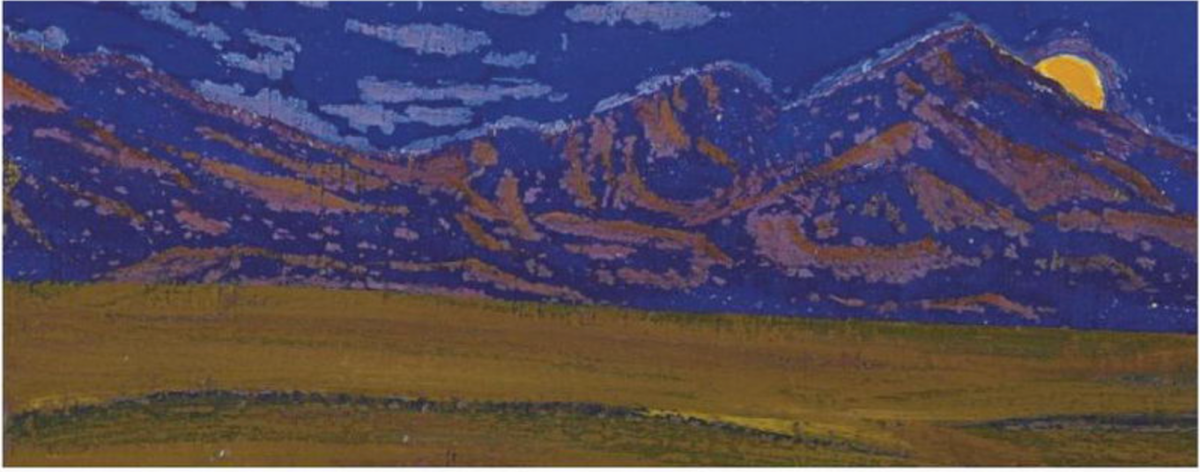
Taklamakan by Nicholas Roerich, 1924. From wikiart.org
When I began to introduce through this column a set of 15 Western pioneers and early explorers who encountered Buddhism, it was an innocent affair: to remind readers of some exceptional characters, the legacies they’ve left us, and my desire to show that cultural curiosity and personal, even spiritual, motivations mattered more to many of them than acceptance by the academy, or fame. These 15 can be easily referenced in my previous article “Messengers of Mind, Cultural Explorers and the Encounter with Buddhism, Part One: A Gallery of Explorers,” which can be used as a kind of glossary as I discuss this group generally and severally in this part two. Calling their lives complex is an understatement. What struck me was that most of them acted and lived in liminal spaces and places, even within themselves.
The list, which can easily be added to and subtracted from, includes dancers and artists because that is my interest and profession. To recap from part one: Giuseppe Tucci, Sven Hedin, Alexandra David-Neel, Ted Shawn, Tyra Kleen, G. I. Gurdjieff, Beryl de Zoete, Arthur Waley, Rolf De Mare, Claire Holt, Ernest Fenollosa, Rene de Nebesky-Wojkowitz, Michael Aris, Lam Anagarika Govinda, and Nicholas Roerich. Each of these people is worth exploring individually on your own, through their own writings, writings about them, their art, their dances, and their lingering reputations.
Writing an article about them and their qualities can’t help but be general. One scholar pointed out that translator Arthur Waley, for all the paths he opened to China and Japan with his honorable translations of lofty literature, never went anywhere. He even refused invitations to visit; but preferred the Japan and China he had in his mind that served his still radiant translations. His translations of Japanese Noh plays are incredibly beautiful, as is Noh itself. Waley was an explorer of the mind, as indeed all of them were.
Courage, discipline, an openness to be changed by the unknown, and a respect for unknown religions characterizes much of their work. They were not there to conquer but to integrate. What is difficult for modern readers to appreciate is that the encounters were very often mutually uplifting. I could never figure out how exotic became a pejorative word. It simply means “from far away.” Indonesian dance was indeed exotic to Dutch travelers in the early 20th century and vice versa: Dutch people were exotic to Indonesians. These were times when anthropology didn’t exist: World Fairs did.
Partial map of Tibet by Dr. Sven Hedin, 1906–08. From loc.gov
When reviewing Ted Shawn’s choreography for the 2,000 dancers in the 1912 D. W. Griffiths film Intolerance, in which the fall of Babylon is shown with nine different ritual dances, it is at once absurd and also, actually, not so off the mark. Roerich, the Russian painter, saw spiritualized landscapes and that is what he painted. He used color to imply spirituality in ways similar to how the modern painter Rothko did. It’s not well known, but Roerich created the sets and costumes and scenario for the groundbreaking ballet Le Sacre Du Printemps (The Rite of Spring) for Diaghilev’s Ballet Russe in 1913, working with composer Igor Stravinsky and dancer-choreographer Vaslav Nijinsky. This ballet shook the ballet and art worlds to their foundations, depicting onstage an ancient ritual so powerful, archaic, and undeniable that Western assumptions, philosophies, and power structures truly met their match. The ballet is a symbol of how dynamic—even cataclysmic—a meeting of worlds can be. In fact, much of the work of these explorers boldly confronted the philosophical materialism of the West and challenged its supposed superiority.
Scene from the fall of Babylon in D. W. Griffiths Intolerance, 1916, choreographed by Ted Shawn with Ruth St Denis. From wikimedia.org
The in-between is where these explorers worked. Michel Aris, a refined British scholar who worked in Bhutan and married into Southeast Asian royalty, had to navigate monastic secrecy, government suspicion, and royal patronage. He’s the epitome of a liminal life.
Academic scholarship is not the touchstone of these explorers’ authenticity. These people took real risks. Alexandra David-Neel was a criminal, illegally entering Lhasa, disguised as a male monk when it was forbidden. She sometimes dressed as a beggar to avoid being discovered. Her writing is dramatic like she was, and it was empathetic, respectful, in awe of what she witnessed. She popularized Buddhism with respect and admiration, not as something less than Western religions. Like other explorers who funded their work through speaking tours in between, they had to deliver captivating accounts.
There was usually financial uncertainty and institutional rejection. Some mortgaged their homes; Roerich sold paintings; and some gave talks. They were often poor. Others were funded by governments, and a long shadow of fascism follows two of my personal favorite writers, Guiseppe Tucci and Sven Hedin. They were explorer-scholars above all, whose brilliant work was later overshadowed by political affiliations with Mussolini and Hitler. But their contributions to knowledge—especially in fields such as ritual, art, dance, monasticism, metaphysics, cartography, and cultural contact—are significant and their works worth reading. It would require much more than this short article can manage to begin to explain the complexities and controversies of it all. No doubt their explorer legacies are compromised by their political behavior.
I am aware of how the dance world has attacked Ted Shawn in favor of trendy concepts, without at all understanding him, the age in which he lived, or what it meant to create dance documentations during the twilight of the Asian kingdoms. His exuberant approach is noted, but not the courage and philosophical insights he provided dance as an art. This has given me a sympathy for others who have been similarly and wrongly disparaged. Shawn was a visionary. The dance festival he founded in the Berkshires, Jacob’s Pillow, is the oldest dance festival in the world. It is considered an honor to perform there. Happily, I was research fellow at Jacob’s Pillow one year and had access to all of Shawn’s work. His life is like 10 lives, for all the wacky outfits he wore in Asia, or, perhaps because of them.
Beryl de Zoete’s book on South Indian dance, The Other Mind, 1953. From abebooks.com
Beryl de Zoete, Tyra Kleen, and even Claire Holt were dismissed by academia, their work being called “feminine,” unworthy of anthropology, dabbling in mysticism (an unfit subject), and primitive art. Gurdjieff and Roerich, who was an artist, were spiritual seekers, lovers of metaphysics and philosophy, and sought for paths and practices of wisdom, particularly initiate traditions. These men each characterized their journeys as inner journeys, metaphysical searches. Both have been called charlatans, something I can’t understand. One was a painter whose work speaks clearly on its own and has stood the test of time; the other was a spiritual teacher looking for better techniques than the West could offer. Neither was trying to be something they weren’t. Their modalities of work were mostly in artistic forms. Spiritual quest is personal; guided more by ineffable experiences than by logic. How can it be anything other?
Ernest Fenollosa, Rene Nebesky-Wojkowitz, Arthur Waley, and Michael Aris weretranslators and literary bridge builders. These men were great scholars, but Waley never had a “real job” and it was often pointed out. He worked for the British Museum and then for himself, living in Bloomsbury, unmarried to his life partner, Beryl de Zoete. Nevertheless, he changed the global literary establishment by presenting Japanese and Chinese literature as noble, wise, and beautiful—not backward, as most of the West considered Asia at that time. Waley never doubted the importance of de Zoete’s work. Fenollosa, a poet at heart, art historian, and scholar, wrote the monumental Epochs of Chinese and Japanese Art, proposing an entirely original way of understanding and classifying art through “cultural epochs.” It was a brilliant, original, and embracing theory. He was one of the first to use a universal theory—cultural epochs—to discuss Asian art.
Ernest Fenollosa’s monumental Epochs of Chinese and Japanese Art, 1913. From goodreads.com
Ted Shawn, Beryl de Zoete, Clair Holt, and Rolf De Mare were dancers who understood and explored form as embodied philosophy, living scripture, and danced repositories of spiritual and historical thought. In retrospect, we see these artist-explorers as ahead of their time in pursuing embodied knowledge as essential to Asian cultures, a topic gaining more attention these days. Alexandra David-Neel, Tyra Kleen, Beryl de Zoete were radically independent women. These women, even the wealthy Tyra Kleen, were risk-takers in every sense because they had a sense of themselves. Breaking conventions, respectably, was what they did.
This short article cannot do justice to even one of these amazing individuals. It would be a fool’s errand to try. There are many different views of these pioneers beyond mine—some admiring, some highly critical. I encourage you to explore those among them who speak to you. Let me leave you with the thought that beyond what they might have misunderstood, done wrong, or illegally, they were courageous risk-taking pioneers, driven by a profound curiosity of what they did not know. And they paid a price to learn what they learned, to become what they became. They were changed by their explorations. Whatever else, Guiseppe Tucci was a pioneer among Westerner scholars suffering from altitude sickness that nearly killed him a couple times. Brave and big, Sven Hedin confessed that the one time he thought he would die was when he was attacked by a pack of wild dogs. Alexandra David-Neel wrote that one reason she learned the ways of Tibetan mystics was so that she would not die of cold and hunger, living off barley paste and yak-butter tea.
To my mind, they are eccentrics, well out of the ordinary, busy on their own paths of personal searching. They were rootless except within themselves, liminal, between worlds, even changing worlds, and in that space where uncertainty brings creativity and insight, they were right at home. The world would be poorer without them and their lives should not be forgotten, nor their work disparaged. They believed in a world of wonder and connection, attributes that would serve us well in today’s fragmented world.
See more
Core of Culture
Related features from BDG
Messengers of Mind, Cultural Explorers and the Encounter with Buddhism, Part One: A Gallery of Explorers
More from Ancient Dances by Joseph Houseal
The post Messengers of Mind, Part Two: Liminal Lives appeared first on Buddhistdoor Global.
My gallery of heroes might be considered a gallery of rogues, and that would not be completely inaccurate. However, here, I’d like to introduce some of the early explorers of Buddhism and show that their work was not fundamentally colonial extraction, but a sincere and often transformative cultural exchange.
Many of these figures worked outside of the colonial context, subverting it and helping to lay the groundwork for today’s global and cultural consciousness. They were adventurer-scholars, mystic-wanderers, and artist-seekers. Some were eccentric charismatics, even where their work supported institutional and academic progress. Others represent the apex of Western academic discipline. They modeled deep cultural curiosity that was mutual among the people they encountered where they traveled and worked.
I am also of this ilk of adventurer in my own work, which continues this summer. When I read aspersions directed toward this crowd, I always sense that something essential is missing. On the other hand, many in this group were accused of being spies. No doubt, some of them were.
I am not only studying these “forgotten” explorers, I am inhabiting their path as modern continuation of the tradition of original expeditionary work. Being a dancer at heart, what I bring is, you might say, embodied testimony, most of all. The reason for that is the same as it was for all of these extraordinary people: the best work corresponds to, and comes from, their essential nature and personalities. These become a kaleidoscope of the human psyche encountering whole new worlds.
Much like the figures I introduce here, my own work has taken me across borders—geographic, cultural, and disciplinary—to preserve sacred movement traditions and assist in their continuity. The explorers gathered in this essay were seekers of something luminous—truth, transformation, beauty, and meaning. They risked comfort and convention to cross into unfamiliar worlds. Their paths were imperfect, often misunderstood, but lit by sincere effort.
This short series will appear in three parts:
1. A Gallery of Explorers, so that readers will have a handy resource showing the cast of characters going forward.2. Liminal Lives, looking at this group collectively and in smaller sets showing their qualities of spirit and comfort moving between worlds; the dangers in what they did.3. Dance Reflections, where I show how these explorers have enriched our knowledge not only of certain ritual dance forms in Asia, but of the very nature of dance itself.
Images courtesy of the author
Giuseppe Tucci (1894–1984)
Italian scholar of Tibetan culture, Sanskrit literature, and one of the first Westerners to access remote Himalayan monasteries. Tucci authored dozens of works on Buddhist art, tantric texts, and Himalayan civilizations. He had a talent for languages, a sensitivity to art, and a gift for looking backwards in time.
Sven Hedin (1865–1952)
Swedish explorer and geographer who mapped unknown parts of Central Asia, including the Taklamakan Desert and parts of Tibet. Although his primary focus was cartography, he was an artist with a mystical reverence for sacred landscapes. A master adventurer and expedition leader, he made maps where there were none.
Alexandra David-Néel (1868–1969)
French writer, opera singer, and Buddhist practitioner. She was a European woman who entered Lhasa disguised as a Tibetan monk. Her writings introduced tantric and Tibetan traditions to a Western readership. She was a colorful character able to hide when needed. Shown here with her Tibetan traveling companion and assistant.
Ted Shawn (1891–1972)
American modern dance pioneer who, inspired by Asian movement and spirituality—especially via Ananda Coomaraswamy and Ruth St. Denis—became a researcher and philosopher of dance, and sought to reclaim the masculine body in sacred and theatrical dance. In 1925–26, Shawn produced unprecedented documentation of pre-modern dance in Asia, in film, photo, and writing. His book Gods Who Dance was one of the first to take ancient Asian dance seriously, written by a dancer. He is the founder of Jacob’s Pillow Dance Festival, which thrives today.
Tyra Kleen (1874–1951)
Swedish artist, theosophist, and ethnographer. Kleen illustrated and described ritual dance and trance in Java and Bali. Her notebooks combine mysticism, movement, and Jungian insight. A rare independent woman traveler and Art Nouveu artist. She lived a life of breaking conventions.
G. I. Gurdjieff (1866?–1949)
Armenian-Greek mystic and teacher. Gurdjieff blended Sufi, Buddhist, Christian, and esoteric systems into a path of inner transformation through sacred movement, music, and self-observation.
Beryl de Zoete (1879–1962)
English dance critic, researcher, author, and translator. De Zoete documented Balinese and Indian dance with sensitivity and scholarly precision, treating movement as cultural philosophy
Arthur Waley (1889–1966)
British translator and sinologist. Waley introduced Western readers to Chinese and Japanese poetry, Zen thought, Noh plays, and Buddhist sutras with literary elegance and intellectual clarity.
Rolf de Maré (1888–1964)
Swedish arts patron and co-founder of the Archives Internationales de la Danse. Director of the avant-garde Ballet Suedois. De Maré supported and directed groundbreaking dance field research in Indonesia, leaving one of the world’s greatest dance documentions. He collaborated closely with Claire Holt. He was widely traveled and a great collector of dance-related artifacts.
Claire Holt (1901–70)
American dance historian and anthropologist. Holt researched Indonesian dances in situ as a system of aesthetic and political meaning. Collaborator with Rolf de Mare. She is known for her original writing and fieldwork. Shown here with a dancer.
Ernest Fenollosa (1853–1908)
American art historian and who helped preserve classical Japanese arts during the Meiji period, including Noh theatre and Zen painting. Fenollosa’s translations and theories were pivotal to the modernist movement. He was awarded the Order of the Rising Sun by the Emperor of Japan.
René de Nebesky-Wojkowitz (1923–59)
Czech-born ethnologist and Tibetologist. Nebesky-Wojkowitz combined deep linguistic training with ethnographic work as field immersion in the Himalayan borderlands just before Tibet’s occupation. Working in Sikkim, Kalimpong, and Nepal from the early 1950s, he translated esoteric Tibetan ritual formulae and introduced protector deities. His landmark book Oracles and Demons of Tibet (1956) was followed by Tibetan Religious Dances. Fluent in Tibetan, he gathered extensive manuscripts and artifacts now housed in Vienna. He considered his translations a form of ethnography.
Michael Aris (1946–99)
Groundbreaking British historian of Himalayan cultures. Known for his work on Bhutan’s early history, and the royal lineages of the Himalayas, Aris brought scholarly sensitivity to oral tradition and sacred kingship. Bhutan and The Raven Crown are books indispensable for understanding the Kingdom of Bhutan. Aris wrote history where none existed, shaping the very identity of the Bhutanese State.
Lam Anagarika Govinda (1898–1985)
German-born Buddhist teacher and writer. Govinda bridged East and West through his writings on Tibetan Buddhism, sacred art, and meditative experience. Known for his spiritual depth and gentle prose, his writing, such as The Inner Workings of the I Ching, has become classic. Shown here with his wife.
Nicholas Roerich (1874–1947)
Russian painter, mystic, and cultural preservationist. Roerich’s Himalayan paintings reflect a spiritual vision of sacred geography. He was ntensely interested in initiate ritual dance, and proposed an international pact to protect cultural heritage.
See more
Core of Culture
Related features from BDG
The AttanPadmasambhava’s Buddha-field of Tantric Dances: Re-establishing Dance in the Narrative of Guru Rinpoche
More from Ancient Dances by Joseph Houseal
The post Messengers of Mind, Cultural Explorers and the Encounter with Buddhism, Part One: A Gallery of Explorers appeared first on Buddhistdoor Global.
A Pashtun boy dances the attan, 2025. From youtube.com
There are many still-living dance traditions connected to the earthly travels of Padmasambhava. Also known as Guru Rinpoche, the legends associated with him include that he journeyed from his homeland of Swat among the Afghans, through India to Kathmandu, to Nabji, Bhutan, and finally to Samye, Tibet, where, in the eighth century, he established Tantric Buddhism in Tibet by means of a danced ritual. Here, I am connecting real dances to prevalent legends. Accordingly, the story goes, Padmasambhava consequently initiated the yogic, meditative dance, cham, as an essential practice of the first Tibetan Buddhist monastic order, the Nyingma. Attan is the Afghan dance Padmasambhava would have grown up with.
Merely connecting these dances—Pashtun attan and Buddhist cham—to the eighth century means that they are at least 1,200 years old. In fact, the dances and dancing cultures that Padmasambhava encountered along the way, and the mystical training he was also accumulating, are much older. One of these dance traditions—a naked dance with Paleolithic origins—is on the brink of extinction. The other three are robust and long-lasting, but also endangered, as much ancient intangible culture is today. Is it the consciousness-transforming qualities of these dances that has contributed to their longevity? Were techniques of mental transformation transmitted and evolved through diasporas and the assimilation of dances?
I will introduce the attan tradition here to allow readers to begin to gain a sense of the actual dances Padmasambhava encountered and probably assimilated. A word about dancing cultures: there are cultures, unlike our own, where dance is an integral expression of life, including spiritual life. Cultures where everybody can dance at the drop of a hat, or on singing a song. Cultures where—if you grew up there or lived there for any length of time—you would inescapably know of the dances and probably how to do them. A simple search on the internet for “attan” will provide examples of dances by children, men, and women.
There are many types of attan, reflecting its widespread use for different occasions. This ceremonial dance is performed at weddings, festivals, and historically, particularly, during periods of strife and war. The attan is often performed with handkerchiefs and swords, serving as a reminder of the performers’ glorious and victorious warrior past. In recent decades, it has been performed with guns. Some regional types include: Kabuli Attan; Wardaki Attan; Paktia/Khosti Attan; Kochyano/Kuchi; Khattak Dance/Warrior Dance; Waziri Attan; and Mehsud Attan. The attan appears, now in many forms, where the Afghan diaspora traveled.
Waziri boys dancing the attan. Here you can see how normal it is to perform the attan; part of growing up and becoming a Pashtun man. From youtube.com
The region surrounding Khyber Pakhtunkhwa (Swat-Waziristan) includes Kashmir, Gilgit, Ladakh, Balochistan, and Chitral. Throughout the area, I’ve been told again and again, there is an extremely old dance—locals say 5,000 years old—that still today permeates the entire region. It is the attan. There is no way that Padmasambhava grew up in Swat, near and among the Pashtun people, and did not know how to do the attan. Everybody can do the attan, and it has endless variations and purposes, from the chaste to the seductive, from the familial to the mystical, celebratory and ritual. It would have suited Padmasambhava’s wizardly tendencies. At the attan’s core is a unique and unusual dance step where the dancer turns on the spot multiple times in one direction, and then immediately turns again the opposite direction, all the while advancing a large circle of dancers. What is provocative about discovering this step is that it is also a characteristic step of Buddhist cham dance, established by Padmasambhava, who came from Swat. This is no coincidence, methinks.
Map of Swat – Waziristan (Khyber-Pahktunkhwa) and surrounding region. From Google Maps
What we think of as Muslim cultures in the central Asian regions of Gilgit and the Khyber Pass, Peshawar, Waziristan, and Swat Valley, are much older than Islam or the advent of Islam there in the 11th century. Most societies in the area practice both Islam and their tribal religions. That means dancing. There has also been a tug-of-war with the attan, and dancing in general, being banned during different periods. The Pashtun people, combining Greek and Central Asian gene pools, are the origin of the word “Afghan,” which was used to describe them from them earliest times. Afghanistan, as a place and a culture, derives from the Pashtun, but today is comprised of many tribes. The Taliban forcefully tried to ban attan as un-Islamic, coarse, and forbidden, just as they did with music. But the popularity and cultural identity of the attan won out, survived the Taliban, and now even has representation in pop music thanks to Coke Studio in Pakistan, which features traditional artists in modern ways. The attan is said to have derived in part from the dance of the chorus in Greek tragedy, which dates to 500 BCE.
Alexander the Great invaded Afghanistan in 330 BCE, and stayed there for three years. A settlement of Greeks remained. This Greek element continues to define the ancient cultural milieu melding Central Asian, Buddhist, and Greek traditions. There is a record in Afghanistan’s Ghandaran art (100–300 CE) of Buddhist figures and practices, as well as of Greek tragedy, Dionysian rituals, and vernacular theater. No doubt early Buddhists in Afghanistan encountered Dionysian rites and theater. Some scholars believe “attan” comes from “Athens” or “Athena.”
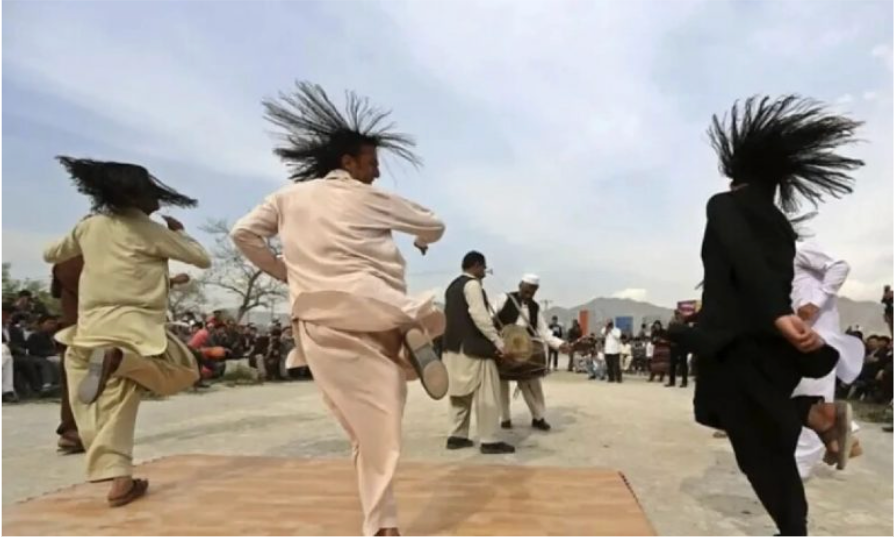
Just as with the study of Buddhism, dance may hold a key to unlocking certain cultural encounters and assimilations. The attan is a pyrrhic dance, designed for battle. It builds into a wild frenzy, displaying extraordinary feats of physical and mental control. It is a male dance, full of jumps and turns, and skillful agility. Young men with long hair dance attan all night, transforming the entire gathering into a magical and mystical generation of spiritual transport, not wholly unconnected to Sufi dervish spinning. In these geographic regions, Sufi dancing is related to attan. It is certainly a dance every Sufi can do.
The characteristic repetition of alternating turns to the right, followed by turns to the left, while forming a large circle of dancers, characterizes both attan and cham, and indeed also the basic movement of strophe/anti-strophe in Greek choral verse and dance. There is reason for further exploration. It is an uncanny similarity. This is the choreography I noticed that gave birth to my idea that Padmasambhava used attan to create cham, along with other dances and tantric practices. Or, more plainly, that attan influenced the choreography and basic steps of cham. In this case, dance research supports the idea that Padmasambhava came from Swat.
Attan performed by young Pashtun men. From youtube.com
Discussing geography needs historical explanation. Of course, Pakistan was created in 1948 and did not exist in the eighth century, when it was a land of Afghans and Pashtuns and other dancing tribal cultures. Padmasambhava is introduced to Westerners as “Indian” and this whole vast region as “India,” and much of it is today. But imagining Padmasambhava as “Indian” is not helpful to understanding his cultural roots. The people who lived, and still live, in these diverse mountainous areas are distinct races, never Hindu, but tribal. This region’s ancient dance forms and religious practices reveal the cultural intersections of early Buddhism with indigenous esoteric traditions. This grafting of movement forms can be understood as Buddhism connecting to much older religious practices, without the filter of Hinduism. The dances of Buddhism can be understood as repositories of pre-Buddhist techniques, practices, and even deity groups.
The short examples of attan shared here could as well be a collection of other types of attan—there are so many. Here, I’ll highlight two main aspects of attan: everybody does it, and, for boys, it is part of growing up. There is the late-night, outdoor, all-male version of the dance, where young men dance themselves into transport, trance, and frenzy. It seems not all that different from Buddhist cham in many respects, although it is wilder and not predictable. Like Buddhist cham, attan performances can last for hours and hours, all night long. This long duration of dancing itself, while often overlooked, is consciousness-altering. Buddhist cham, too, has clear martial elements and purposes, and there are many stories of cham being used in battles and warfare. Pyrrhic frenzy is one use, sword-stroke practice and fighting is another. Until the 20th century, cham was always performed with real weapons.
Ferocious frenzy to instill fear, astonishing skills to display martial finesse, and physical superiority characterize pyrrhic dances. Attan is all of these. I have had the good fortune to see many attan performed in the flesh. There used to be more “authentic” attan available to see online, but much has been removed and a search for “attan” today will likely yield a lot of wedding attans, some performed with guns, most recorded for social media. Today, handsome men in skintight Western suits perform attan at weddings as celebratory performances. Women perform the attan now—everybody does attan—but women’s dances in this region have their own choreography, more feminine and curvaceous.
Please enjoy these several short videos of attan. They are offered to feature the remarkable turns and extreme head rolls, also executed in both directions. Traditionally performed by men in societies where the genders were largely separated, it is clear that the attan was an ecstatic dance, inducing young men into trance states and bringing their bodies into physical states of exaltation and transportive endurance. This type of attan dance connects to Sufi dervish spinning, which, notably, turns in only one direction; and also with erotic dance entertainments, using attan as a choreographic and musical base for endless variations.
Pashtun attan, 2020. Observe the accelerating rhythm and dexterous head-rolling. From youtube.com (Starts 26:00)
Exploring parallels and even similarities between dance traditions in Swat Valley, Kathmandu, Bhutan, and Tibet provides a broader lens on the diffusion of Guru Rinpoche’s influence. Local legends, indigenous mystical mind-body techniques, and pre-Buddhist practices coalesced into evolving Buddhist dance forms. The Swat Valley’s folk traditions of attan, an ecstatic, trance-inducing warrior dance, resonate with tantric dance practices attributed to Guru Rinpoche. Accelerative rhythms, spiraling footwork, and the taking on of divine virtues as part of a mystical and metabolic transformation—aspects shared by attan and cham—help to trace continuities between Central and South Asian esoteric traditions, through time and the Himalayan landscape, making an inherent sense expressed as long-lasting dance traditions.
Waziri attan, 2018. This gentle attan performed by young men has an uncanny similarity to Buddhist cham. Here, the turning in both directions is done as a half-turn, making this attan a graceful continual expression. The dancer on the right displays in his body, the torque of gyroscopic energies at the core. From youtube.com.
By weaving together dance ethnography, cultural philosophy, textual readings, and visual art study with actual tantric practices, we can construct a richly layered understanding of how living dance traditions embody and perpetuate the myths of Guru Rinpoche. This comprehensive approach situates these dances not merely as performative relics but as dynamic, living expressions of spirituality and tantrism, alive with the transformative power of their original ritual sources. Such is the ancient and still vital dance called attan.
•••
I am exploring the attan, along with Newar Buddhist Charya Nritya, the Nabji naked dance, and Buddhist monastic cham with fellow researcher Karen Greenspan in an ongoing course through 18 May. Please join in!
See more
Core of Culture
Related features from BDG
Padmasambhava’s Buddha-field of Tantric Dances: Re-establishing Dance in the Narrative of Guru RinpocheWho is Padmasambhava?Precious Guru: Tracing the Wild and Sacred Legacy of PadmasambhavaMystical Dances in the Kingdom of Bhutan, Part 1: A Black Magic Dance at the Core of Bhutan’s Founding
More from Ancient Dances by Joseph Houseal
The post The <i>Attan</i> appeared first on Buddhistdoor Global.
Zandokpalri, 2012. Guru Rinpoche’s Copper-Colored Palace in another dimension. From Zandok Palri: The Lotus Light Palace of Guru Rinpoche, Visions of the Buddhist Paradise in the Sacred Kingdom of Bhutan. Gatshel Publishing, 2012. Note the many dancers in, above, and around Zandokpalri. This painting depicts the journey to Zandokpalri by a mystical visionary, who is learning a dance from dakinis on the yellow platform to the left. Image courtesy of the author
Padmasambhava, also known as Guru Rinpoche, occupies a central place in Tibetan Buddhism as a master of tantric teachings and a powerful figure of spiritual transformation. His life and legends bridge the realms of history, mythology, and ritual performance, reflecting his diverse roles as a mahasiddha (great tantric adept), a healer, a sorcerer, a master of sexual yoga, and a dancer. His identity functions outside of normal time, moving between dimensions of existence. Guru Rinpoche is a composite archetype, a mythic-religious figure so great he is called the Second Buddha for the establishment of Tantric Buddhism in Tibet, and for his continuing protection and dissemination of spiritual teachings.
Padmasambhava, by contrast, was a real person, and the foundation of Guru Rinpoche’s identity. Regarding the actuality of dance, it is sensible to explore the human activities of Padmasambhava, including everything we can know about the dances he learned, performed, and synthesized, as well as the esoteric tantric practices he learned, performed, and evolved.
Mahayana Buddhism was a metaphysical earthquake. What had formerly been a set of practices established by the historical Shakyamuni Buddha became a religion of blown-out metaphysics. Shakyamuni became more like an avatar: one of countless buddhas: buddhas of different eons, buddhas of specific attributes, buddhaverses, buddha-fields, Five Wisdom Buddhas, the Primordial Buddha, on and on, as far as the metaphysical imagination could go.
The Eight Manifestations of Guru Rinpoche, cham performance, Daktok Monastery, Sakti Village, Ladakh, 2014. Photo by Jonathon Kendrew
“The Eight Manifestation of Guru Rinpoche” is one of the earliest textual, liturgical, philosophical, and devotional expressions of Guru Rinpoche and can be found in a hagiographic textual account, The Lotus Born, a religious biography, ascribed to one of Padmasambhava’s sexual tantric consorts, Yeshe Tsogyal. This schematic: “The Eight Manifestations of Guru Rinpoche” is also an early ceremonial cham, or monastic yogic dance, more like a procession, or tableaux vivant, than what we would recognize as dance.
In this new Mahayana construct of avatars and buddhafields, Padmasambhava becomes just one of eight manifestations of Guru Rinpoche. In fact, Shakyamuni Buddha, the source of Buddhism, also becomes an avatar of Guru Rinpoche, one of the eight, and we can see how the metaphysical identity of Guru Rinpoche became an aggregate divine power transversing realms of existence, traveling across time, assuming different shapes, providing teachings over the centuries. Tibet was not a literate society, and a ceremonial cham like “The Eight Manifestations of Guru Rinpoche” instructed the people in the metaphysical identity of Guru Rinpoche, much like stained-glass windows taught Christianity in European cathedrals.
A scene of wrathful female khandum dancing in the bardo after-death experience. Lamyuru Monastery, Ladakh. The Tibetan Book of the Dead (Bardo Thodol) is ascribed to Guru Rinpoche. Image courtesy of Core of Culture.
Whether or not any of this true, or merely spiritual fantasy wrapped up as orthodox teaching, the narrative of Padmasambhava/Guru Rinpoche is characterized by dancing. Real dancing by real people. That is the only way dance transmits. Extant dance traditions in Swat, in Kathmandu, in Bhutan, and throughout Tibet, provide a living testimony to the role of dance at the core of Guru Rinpoche’s physical and spiritual journey from Swat to Tibet. Until now, there have been no researchers in dance who could link the stories of Padmasambhava to actual dances. Now we can.
Dance researcher and writer Karen Greenspan is joining me in offering an exciting new workshop course with Yangchenma Arts & Music on Sundays from 27 April–18 May: Padmasanbhava’s Buddhafield of Tantric Dances: Re-establishing Dance in the Narrative of Guru Rinpoche.
Karen and I have dedicated decades of our lives to researching the dances associated with Padmasambhava across the Himalayas, India, and Tibet. We’ve documented them, learned them, shown them in museums and in writing. We’ve written books. We’ve taken many trips. We know many dancers. In this workshop course, Karen Greenspan and I connect the dances to the legends, the geography, the mysticism, and religious teachings associated with the larger-than-life character of Padmasambhava, and re-establish dance in the narrative of Guru Rinpoche. It’s always been there, but perhaps it has been avoided or ignored by Westerners studying Buddhism. This is clearly changing. In fact, there are so many examples of contemporary dance practice connected to Guru Rinpoche that we could not possibly mention them all in our workshop course.
Register here
Each session over the four weeks will focus on one key facet that defines Padmasambhava’s dance aspect:
Week 1: Who is Guru Rinpoche?Week 2: The Earthly Travels of Padmasambhava (including dances and charnel grounds)Week 3: Treasures, Treasure Revealers, Treasure DancesWeek 4: Contemporary Dance Practices and Guru Rinpoche
Padmasambhava’s association with dance is particularly significant in the Himalayan region, where the sacred teachings are embodied and preserved in ritual dances. These dances are themselves preserved in religious ceremonies and folk traditions, in solo and group dances, each filled with symbolic meaning, while actualizing consciousness transformation in performance. Padmasambhava was an esoteric master and expert dancer, moving through dancing cultures and several extant dance traditions in Swat, Nepal, Bhutan, and Tibet. It is astonishing that these dance traditions still exist in each of these places.
Guru Rinpoche’s legacy is found not only in texts and personal devotion, but in the dancing body. The dancing body is where his greatest teachings come alive and are preserved, as they have been—some for more than a thousand years—within the bodies of dancers who transmit them to other dancers. This is how dances continue. The dances themselves sustain the legends of Guru Rinpoche, even in the absence of written texts.
While modern academic scholars debate the historicity of Padmasambhava, his impact on cultural and spiritual life is unquestionable. The transmitted dance traditions and living performances connected to his legacy demonstrate a fusion of mythic storytelling, ritual drama, and sacred movement. Dance, in this context, transcends mere performance to become a medium of spiritual practice, a manifestation of enlightened activity, and a means of preserving ancient wisdom.
Padmasambhava, clay statue, Bhutan, Photo by Tony Bowall. Copyright Tony Bowall
Sacred dance traditions are repositories of spiritual techniques and teachings. It is only since the 20th century that Westerners have cultivated the skills to approach these dances with any genuine understanding of what they really are. Dance research is a relatively new discipline, especially within Buddhism. Karen and I greatly enjoyed putting this new workshop course together to see what research there was, and to bring it together in one place. Exhilarating, in its own way, when something sensible emerges.
Next month, I will introduce the dances of Swat, Kathmandu, Bhutan and Tibet, which, taken together or rolled out along the temporal sequence corresponding to Padmasambhava’s travels, reveal a coherent process of choreographic evolution and yogic application. The Guru’s dance journey parallels an inner journey and refinement. Padmasambhava traveled as well through charnel grounds en route from Swat to Tibet, learning and practicing tantra with enlightened yoginis. It makes sense that what Padmasambhava learned as a dancer and as a tantric adept, along his way from Swat to Samye, accumulated into the apex of establishing monastic Tantric Buddhism in Tibet by means of a danced subjugation of hostile energies. Samye is where Padmasambhava established Vajrayana Buddhism in Tibet and set up the oldest tantric monastic order, the Nyingma, for whom the practice of danced cham was central. For the first time, we can piece together the dances and the tantric practices that defined Padmasambhava’s inner and outer travels. In sifting through what is legend and what is “real,” the dances are real. Please join as we explore the ancient dances connected to Guru Rinpoche.
The Eight Manifestations of Guru Rinpoche, an embroidered thongdrel is unfurled on the wall of a monastery in Bhutan, 2008. Screenshot. Image courtesy of Core of Culture.
See more
Core of Culture
Related features from BDG
Who is Padmasambhava?Precious Guru: Tracing the Wild and Sacred Legacy of PadmasambhavaMystical Dances in the Kingdom of Bhutan, Part 1: A Black Magic Dance at the Core of Bhutan’s Founding
More from Ancient Dances by Joseph Houseal
The post Padmasambhava’s Buddha-field of Tantric Dances: Re-establishing Dance in the Narrative of Guru Rinpoche appeared first on Buddhistdoor Global.
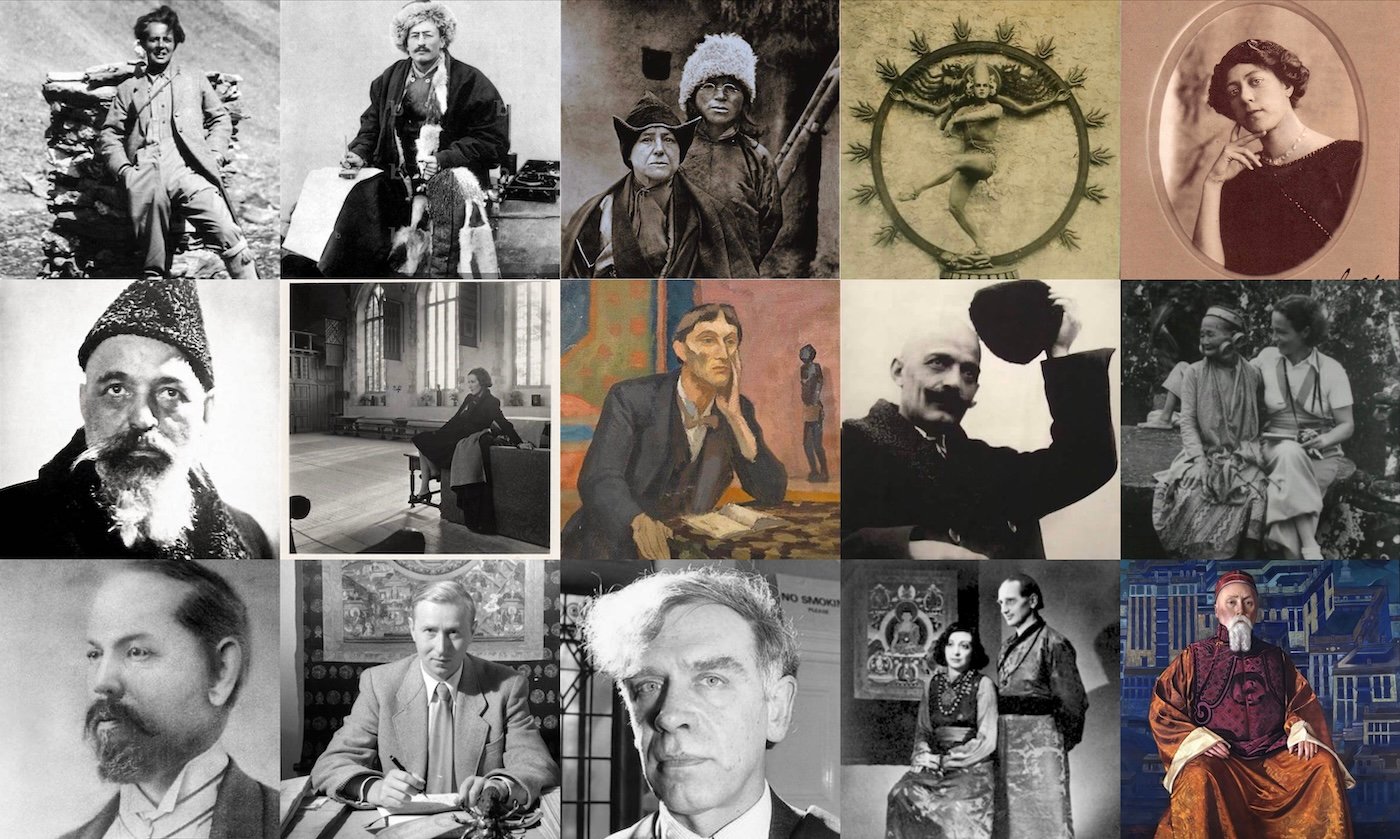
Astrological Astralplane, painting by Peter Max, c. 1965. Copyright Peter Max. Image courtesy of the author
In 1855, Walt Whitman published Leaves of Grass, a collection of poems including one that has come to be known as “I Sing the Body Electric.” To Whitman, who had an almost Daoist relationship with wild Nature, the body and the soul were one thing: obviously, literally, essentially; how otherwise? This influential poem—an early and masterful work in free verse—begins:
I sing the body electric,The armies of those I love engirth me and I engirth them,They will not let me off till I go with them, respond to them,And discorrupt them, and charge them full with the charge of the soul.
Was it doubted that those who corrupt their own bodies conceal themselves?And if those who defile the living are as bad as they who defile the dead?And if the body does not do fully as much as the soul?And if the body were not the soul, what is the soul?
“Soul” is a useful term, like “mind” or “spirit,” to delineate the interior reality and essence of a person. Whitman wrote a poem, not a theological tract. Buddhists sometimes get hung up on the word “soul.” They shouldn’t. The language is artistic, poetic, sensual, unafraid to be plain. Whitman asserts that the soul is also none other than the body. The body is sacred, the body is the vehicle for all understanding. The senses are the basis for reasoning. Complete devotion should be full-body. This is the essence of Buddhist Tantra and every other kind of tantra. Ritual dance in Buddhism, dance-as-meditation, deity visualization, and becoming one with Nature, indeed meditation itself, are full-body acts of self-cultivation. There is no separation of physical reality and spiritual action. Breath is the path to enlightenment.
A practitioner’s painting, showing the chakra system of mandalas, inner geometries, and figurative symbols within the human body. Artist unknown. From Core of Culture
Whitman’s lush concept of the full-blooded holiness of the flesh finds a parallel in the tantric concept of Body Mandala. Or Body-as-Mandala. The chakras—energy centers that align with the spine and torso and head—are each a mandala in themselves. Mandala simply means “circle” in Sanskrit. Mandalas come to symbolize all aspects of life, seen and unseen, felt and discovered, depending on their use and level of abstraction in design. The Body Mandala essentially functions in two ways: first, where the human form is the central focus of a geometric mandala, which defines the deity field of the deity. The human form becomes a structural component of a geometric structure. Conversely, the Body Mandala is also a mandala—or deity field—in the shape of the human body. The body is the locus of spiritual and mental cultivation. The unseen subtle body is depicted; the circulations of energy and intention. Sacred geometries appear within the human form, distinct from mandalas where a human body is ensconced within a geometric form.
The Tantric Body visualizations of Vajrayana Buddhism. Standard student illustration. Artist unknown. From Core of Culture
Tantric art, especially within Hindu and Buddhist traditions, makes extensive use of the human form as a symbolic map of the universe. They highlight the spiritual and energetic aspects, circuits, channels, pathways, and quantum dynamics of energetic transformation of the mind and its condition, and so inexorably, the body and its condition. The parts and components of the body are aligned with various cosmic energies, deities, virtues, and sacred principles. The process of activating these structures is a technique to divinize the body; to rarify the metabolic consciousness toward a more pure apprehension of essential reality.
There are any number of specific techniques to do this. Buddhist monastic cham and Newar Charya dance are two distinct traditions with different ways to divinize the body using ages-old techniques, passed down since ancient times. Remarkably, both of these traditions are practiced today with vitality, mystical skill, evolved creativity, and danced excellence. Buddhism is a living repository of pre-Buddhist mystical techniques, connecting contemporary practice with meditation skills that have roots receding into prehistory.
The late artist Keith Haring paints symbolic designs on postmodern dancer Bill T. Jones. New York, 1983. Copyright Getty Images. Image courtesy of the author
Westerners have also availed themselves of the concept of Body Mandala from the Middle Ages until today. Artist Peter Max created Astrological Astralplane in the 1960s as part of his Cosmic Art period of output. This astral plane is peopled with sky travelers, wise men, and messengers leaping through their field of Peace and Love, as wisdom-generating heads stabilize the expanding Earth consciousness in this mod mandala composed of human bodies. Three decades later, the iconic singer Grace Jones transformed herself into a geometric icon of radiant self-power, a Body Mandala of liberated self-expression.
Jamaican singer Grace Jones, album cover for Island Life, 1985. Composite photo montage by Jean Paul Goude. Image courtesy of the author
Another pop artist of the same era as Jones, the late Keith Haring, used the human form to communicate myriad states of consciousness and being. He painted bodies, such as that of the pioneering choreographer of identity politics, Bill T. Jones. I’ll conclude this short homage to the Body Mandala with the very best of 1980’s New York downtown arts culture; a surreal meditation and collaboration between Keith Haring and Grace Jones, with appearances by Timothy Leary and Andy Warhol. Singing the body electric. Erecting the Body Mandala. Haring directed this early music video and painted the extraordinary dress as a graffiti-symbol mandala, resulting in an apex expression of the 1980’s avant-garde pop movement.
“I’m Not Perfect (But I’m Perfect for You)” featuring Grace Jones. Directed by Keith Haring, 1986. From youtube.com
The human body in Tantric and Buddhist art is an intersection of art, meditation and energy. These traditions recognize that that the body is a sacred vessel, a geometric temple, a cauldron for spiritual transformation, transcending taboo. In many tantric depictions, the body is shown radiating light, constructed according to sacred geometries, gird with patterns, halos, ensconced in a web of dazzling powers, symbolizing the body’s connection to the divine and the cosmic order. Whitman concludes his well-known poem:
The exquisite realization of health;O I say these are not the parts and poems of the body only, but of the soul,O I say now these are the soul!
Man as mandala: Vitruvian Man by Leonardo da Vinci, c. 1490, for the book Divina proportione by Luca Pacioli. Image courtesy of the author
See more
Core of Culture
Related features from BDG
Tantric TransformationIsadora Duncan, Prajwal Vajracharya, and the Dancers of Huai-nanBe Inspired
More from Ancient Dances by Joseph Houseal
The post I Sing the Body Electric appeared first on Buddhistdoor Global.