Inner Dance Teachings: Techniques Common to Zen Meditation and Noh Movement
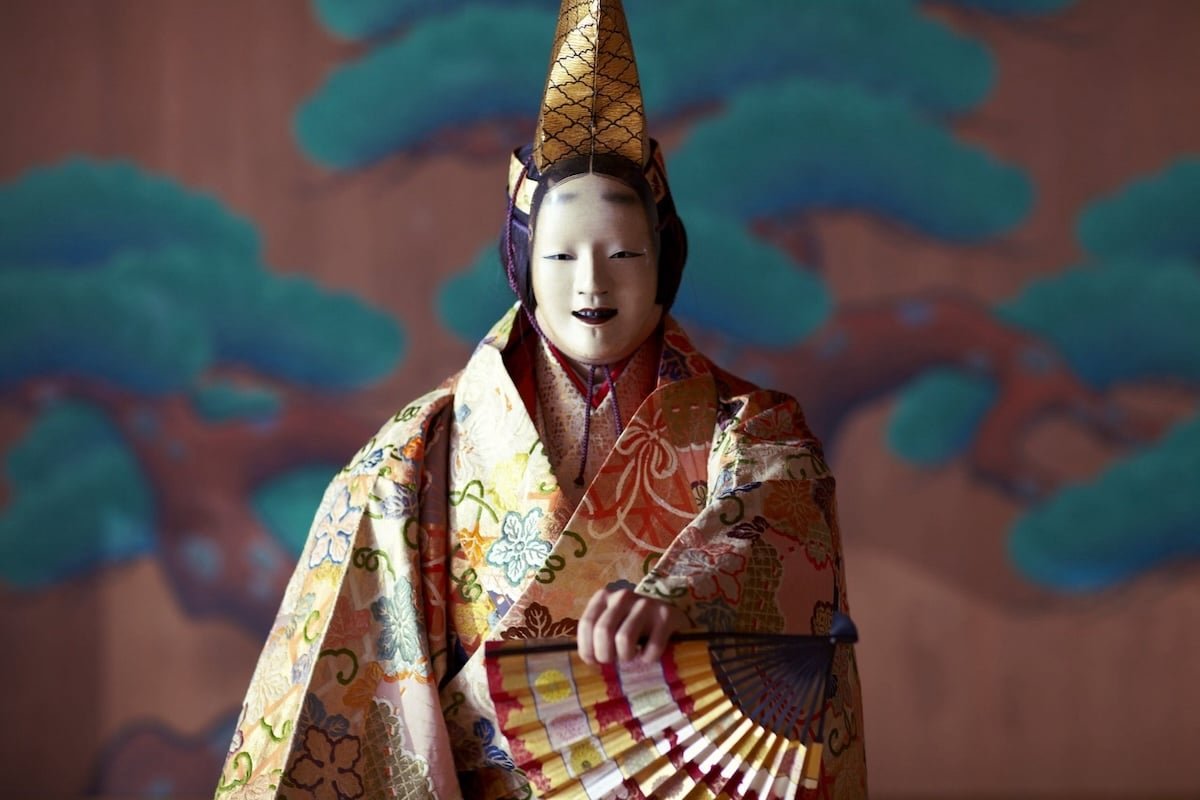
Umewaka Rokuro performs Hagoromo. January 1943. From wikimedia.org
Intuitive response, nobility of spirit, beauty, and the worthiness of an offering are characteristics shared by a Noh actor and a spiritual adept. Altered experiences of space and time are what meditative practice gives to consciousness; and what the forms, paces, and rhythms give to Noh.
Noh dance is called mai, which means, “patterning.” By contrast, the dance of kabuki is called odori, which means “moving the arms and legs around.” Because they are so different, kabuki and Noh are very helpful in understanding the other. The older dances of the miko, performed by Shinto shrine priestesses, are called mai, as is the movement of the performers in the samurai narrative performance form kowaka, which also pre-dates Noh. Kowaka is an art resonant with sacredness, abstraction, ritual purity, and divine communication. These earlier forms are associated with techniques of consciousness training. This inner cultivation came to characterize noh as well, being the inheritor of elements from both kagura and kowaka.
The simple techniques outlined here are not exclusive to Zen meditation but pertain as well to most forms of Buddhist meditation, tantric and exoteric alike. Zeami (c. 1363–c. 1443), founder, playwright, and theorist of Noh), was himself a practitioner of esoteric Buddhism, which is in some ways similar to the older and wilder Chinese Daoism, relying on techniques of breath, metabolic mastery, the movement of energy, and visualization. Zen is unique in its widespread adoption by artists, aristocrats, and commoners.
These techniques of mind and meditation are relevant to performance because they are biological, such as breath control, or mental, such as inner visualization. Zeami combined these and other sophisticated meditation techniques to create living characters so compelling in performance that they have endured more than 700 years.
As in meditation, conscious awareness and control of the breath is used in Noh to slow metabolic processes, to unify inner and outer realities, and to function as a rhythmic basis, a pulse to carry the contracting and expanding rhythms of a Noh play. The mind and energy ride on the breath.
A Zen monk meditating in front of a rock garden, Jusho-in, Kyoto. Image copyright Jusho-In. Used with permission
Unlike seated meditation, Noh moves the meditator, and beyond that is performed as an art for others to observe, unlike tai chi, for example, which is not for audiences. One reason for the slow pace of Noh is that the amount and nature of mental activity sustained by the Noh actor requires a stable continuum of consciousness.
While supporting a contemplative state of mind, the actor dances, recites poetry, and portrays a character’s defining spiritual condition. The body, basic posture, and movement style of Noh sustain complex and skillful mental action—of both meditation and performance—simultaneously. A Noh actor remains in this biological state of consciousness development throughout the play. It is surely a type of spiritual attainment. A great Noh performance ends in breathtaking silence. The concentration is palpable.
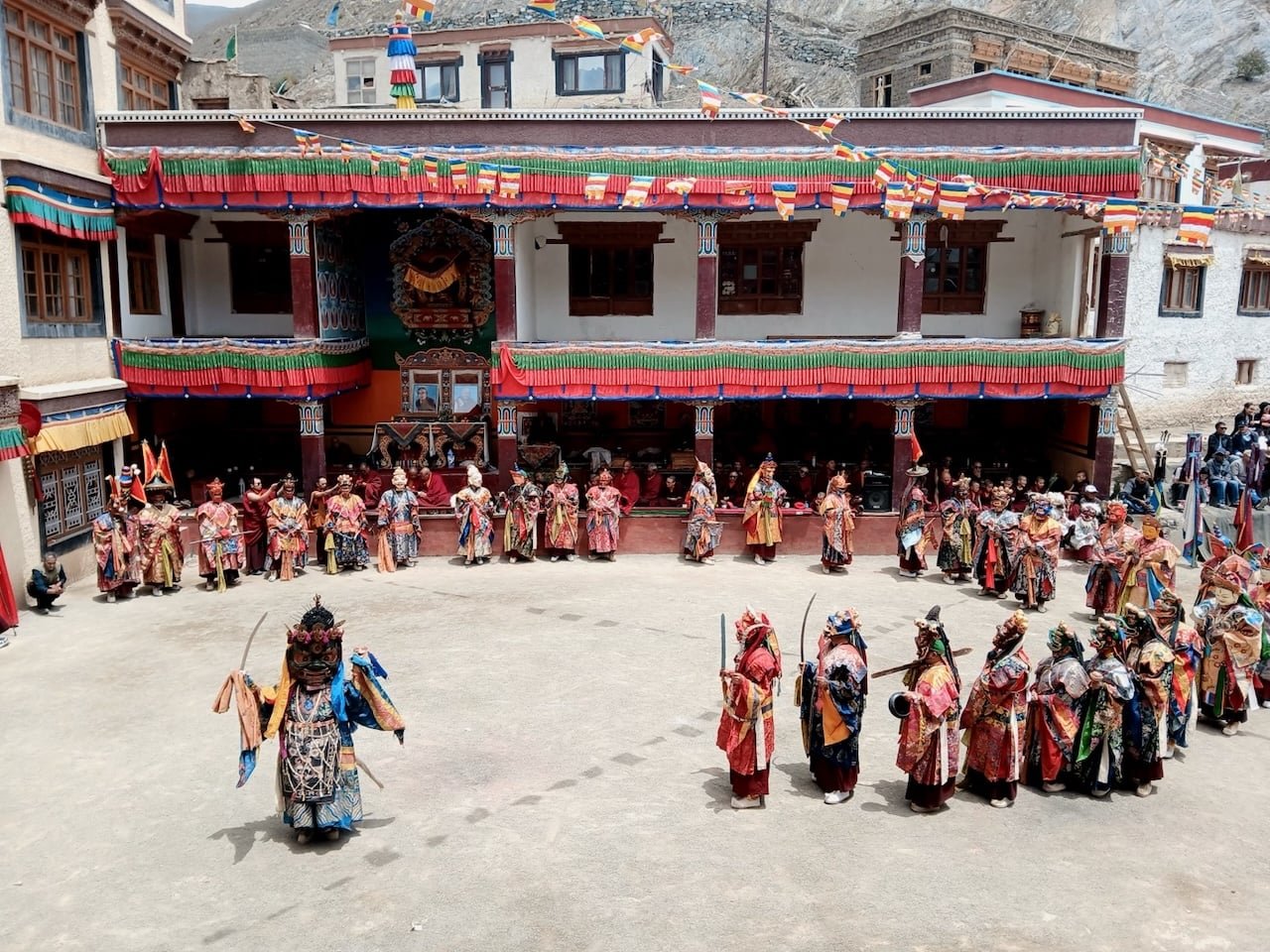
Vajrayana cham dance, protective deity, Tibet. From greattibettour.com
This function of Noh movement and dance finds a ready parallel in the dances of Vajrayana monks, inasmuch as their dance form, cham, also serves as a vehicle for elaborate meditative visualization. In Nepal, the grounded tantric Buddhist dance charya nritya also serves the function of providing a stable body condition for undergoing visualized transformation into a deity. These Buddhist dances are characterized by the dancer’s ability to sustain a transformed consciousness during performance.
Prajwal Vajracharya performing charya nritya at the Victoria & Albert Museum, London, 2009. Photo copyright Jonathan Greet for Core of Culture
Zeami transformed the nature of visualization practice for performance. In meditation, any number of mental objects can be visualized as a step toward the realization of the true nature of being. It might be light; it could be water. In the Tibetan tradition, it could an elaborately described protective deity in an equally elaborate mandala.
This type of visualization is advanced. Dancing in this state of meditative practice is a mystical accomplishment. One basic Zen meditation technique includes the visualization of the lower belly as an ocean of energy and the heart as the Moon. The meditation is one of internally shining moonlight on the ocean, until that point where the physical body experiences a material dissolution and the visualization lets go, leaving the practitioner with an experience of emptiness and bliss. The practitioner participates in the qualities of the scenes visualized, such as reflection, luminosity, instantaneous speed, and expansion.
In addition, A Noh actor is concerned with sharing an experience of rarified consciousness with an audience. Visualizations for the masked and heavily costumed Noh actor are used to produce a deep internalization of emotion by using the breath to direct mind and energy into the lower abdomen, the hara.
Using poetic imagery, which, in classical Japanese poetry, is couched in terms of nature, indirectly reveals the emotional condition of a character. By visualizing sites described poetically as emotional memories of a tragic character, the Noh actor then projects the imaginary landscape, the site of an unforgettable event, to which the ghost returns. Visualization in Noh is, in fact, a poetically envisioned emotional state shared with a receptive audience.
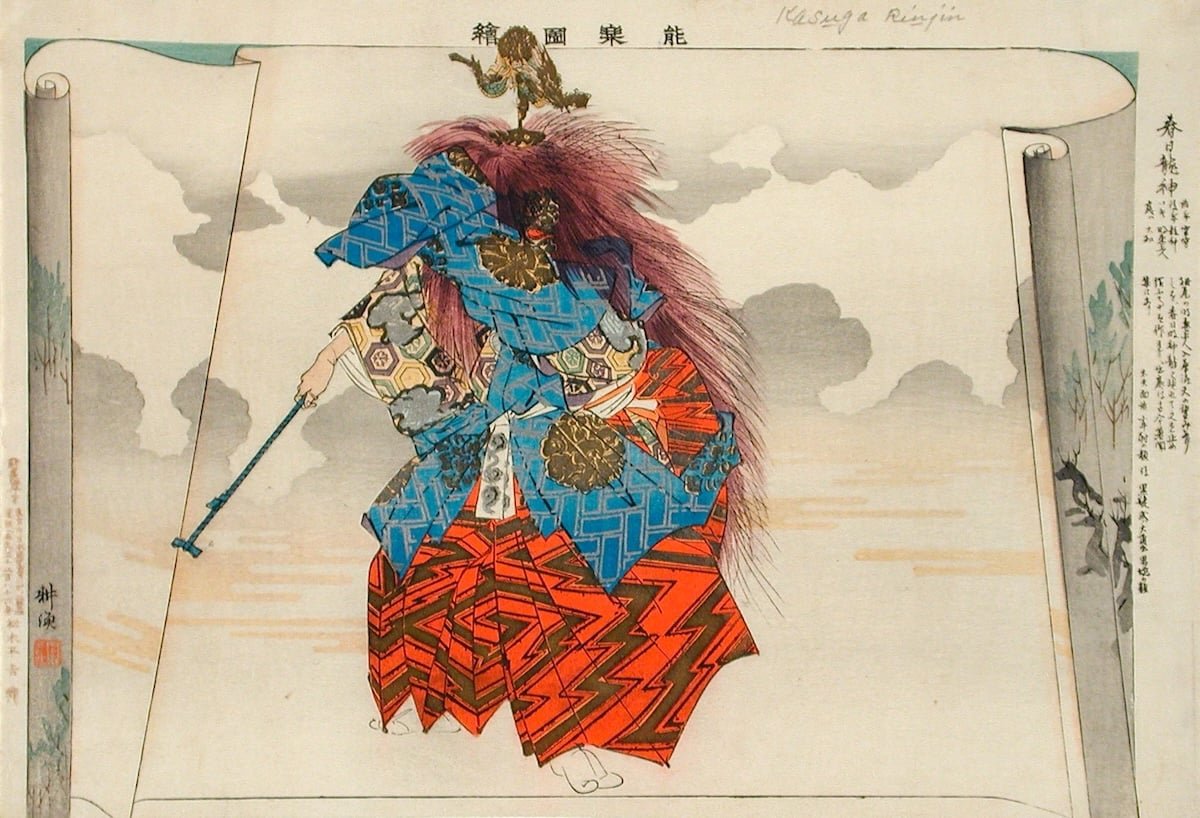
Scene from the Noh play Kasuga Ryujin. From lacma.org
There is a major distinction between Noh and meditation. Noh is an art form. Meditation is a practice of inner cultivation. It is unconcerned with theatrical effect. Even among Buddhist dances by Himalayan monks and priests, often in private, the goal is not theatricality. In Noh, Zeami aspired to give his shogun the most exquisite dramatic art form in the world. He succeeded. While it is Zen, it is opulent Zen in a magnificent era. The Shogun Yoshimitsu’s Golden Pavilion is kindred art with Zeami’s Noh. Gorgeousness and sophistication meet understated elegance and spiritual impact.
Zeami taught the practice of mokusen shingo to Noh actors. He borrowed this from meditation, but it is also used in certain martial arts. It is the practice of seeing oneself in the mind from behind, as if one were behind oneself, looking at oneself. A kind of remote viewing. This practice is basic to Noh, part of the continuum of mental and physical activity for the actors. The act of one’s seeing the dancing self from the back as one moves forward, projecting and inhabiting a fate-filled landscape, further objectifies the performer and beautifully elevates the artful mastery of mind: seeing within the boundless spatial context of a karmic landscape.
Such mental actions rarify the nature of a Noh performance. This technique is also used by monks and martial artists to see oneself from 360 degrees; sometimes placing oneself at the center of a cosmos; at other times cultivating heightened sensibilities as a warrior. Noh movement is designed and choreographed to sustain just such advanced mental techniques during performance.
Kyogen master Shigeyana Sensaku, Kyoto, 1947. Kyogen is Noh-style comedy. From wikimedia.org
The accumulation of energy in the lower abdomen, hara—the ocean of endless universal energy—is widespread in meditation, and within Chinese and Japanese martial arts. Again, is it fundamental to Noh as well, a basic physical habit mastered early on.
Breathing into the hara to accumulate and store energy is to move one’s essential identity down and away from the head, indeed to “drop the mind” into the belly and to universalize the self, even to the point of dissolution of the material body.
The hara is also home to the body’s center of gravity. Emphasizing this accumulation of energy gives the Noh actor-dancer an appearance that is at once grounded, moving from a deep universal center, and, at the same time, appears to be gliding or floating. This technique gives Noh movement gravitas and a grace.
Like meditation, like martial arts, Noh relies on dynamic silences, purposeful stillness, and an experiential context of tranquil intensity. Not only is the body objectified and ritualized, but so is the entire performance context, including the audience.
Noh play Kayoi Komachi, from A Day of Rare Buddhist Dances, Victoria & Albert Museum, London, 2009. Photo copyright Jonathan Greet for Core of Culture
This article adapted from Buddhist Dances, Movement & Mind by Joseph Houseal. Motilal Banarsidss, 2025. An online course based on this book is being offered by Yangchenma Arts & Culture: https://learn.yangchenma.org/courses/buddhist-dances-movement-mind-part-1
See more
Core of Culture
Related features from BDG
Noh and ZenScattering Petals, Falling Leaves: Spring in Noh and the Japanese Sense of TransiencePerforming a Noh Dance for Merce CunninghamThe Ancient Noh Stages of Sado, the Isle of ExileRarified, Recondite, and Abstruse: Zeami’s Nine StagesPure Land Buddhism in Noh: The Shuramono Plays of ZeamiBeauty and Sadness: Reflections on a Japanese Noh Play
More from Ancient Dances by Joseph Houseal
The post Inner Dance Teachings: Techniques Common to Zen Meditation and Noh Movement appeared first on Buddhistdoor Global.