The Firebird Flies Again
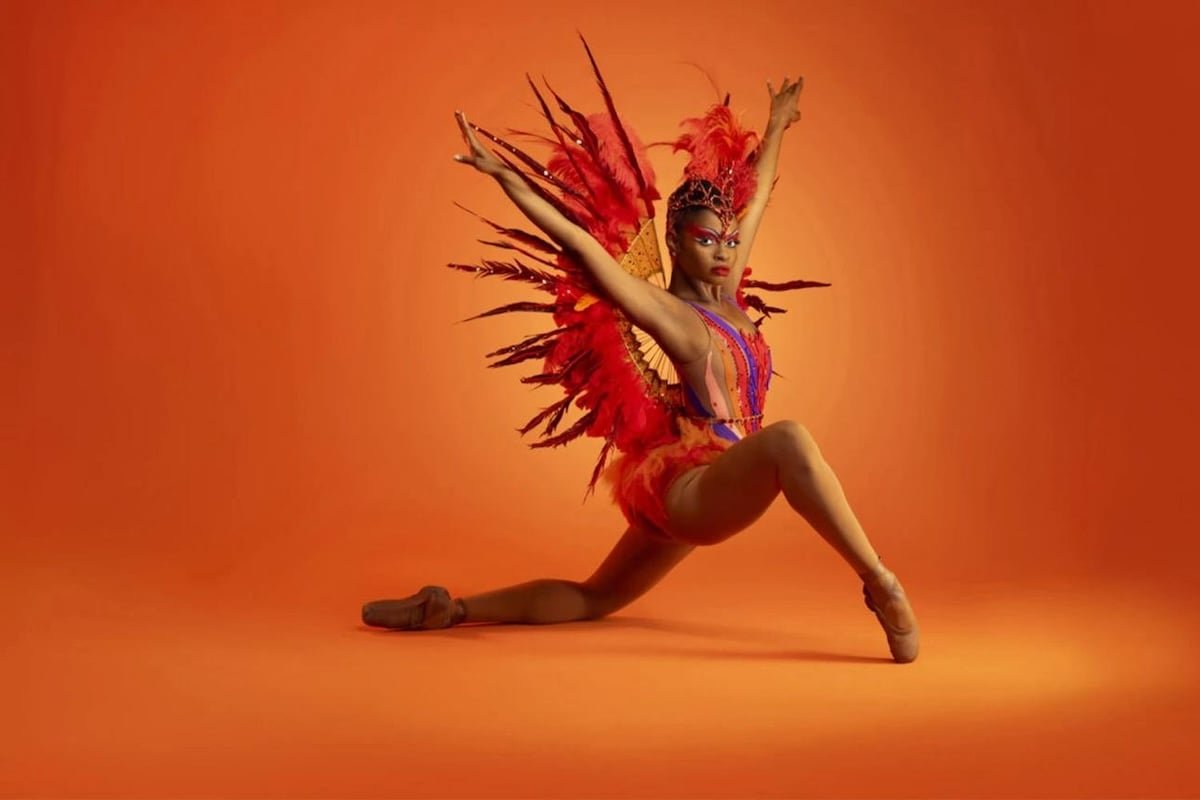
Alexandra Hutchinson as the Firebird in John Taras and Geoffrey Holder’s The Firebird. Photo by Nir Arieli. Image courtesy of Dance Theatre of Harlem
Ballet used to be exciting.
Audiences came to the theater to be astonished. They expected virtuosity, exotic tales, extraordinary characters, visual spectacle, and the best dancing anywhere. When the Ballets Russes swept through Europe and America in the early 20th century, they brought something more than accomplished ballet. They presented an art form reinventing itself, absorbing revolutionary ideas about music, painting, movement, sexuality, and the possibilities of human expression. Ballet was an adventure.
Something of that excitement returned to Chicago’s Auditorium Theatre on 17 October, when Dance Theatre of Harlem presented three ballets that, taken together, offered a remarkable lesson in cultural intelligence: how dance carries knowledge across generations, how it changes with the people who perform it, and how its continuing evolution expands our understanding of what human beings can become. A tradition is not necessarily preserved by keeping it unchanged. Sometimes its vitality depends on new people entering it, inhabiting it, and making it their own.
Arthur Mitchell dancing Balanchine, by Martha Swope. image from Jerome Robbins Dance Division, New York Public Library for the Performing Arts
Founded in 1969 by Arthur Mitchell and Karel Shook, Dance Theatre of Harlem emerged during a period of profound social change in America. Mitchell, the first Black principal dancer of New York City Ballet, challenged a deeply entrenched assumption: that classical ballet was essentially a white European art, belonging to particular bodies, institutions, and cultural histories. New York City Ballet was choreographer George Balanchine’s creative home from where he brought to the world ballet as a modern art.
Attending his new ballets during the 1960s and 1970s was thrilling: seeing ballet ascend heights of formalist expression borne by a sublime musicality. Balanchine used balletic idioms in composition, so we knew it was ballet—but what he did with it was so riveting that it brought new attention to this creative revolution. I’m so glad I was alive then, to be there for a lot of this. Ballet was exciting. For Balanchine, artistic form could transcend racial conventions, and in Arthur Mitchell he found one of his finest exponents. Balanchine chose Mitchell to debut his revolutionary ballet Agon, in 1957, with a white ballerina. This was shocking in its time. But the shock paled in the brilliance of the dance.
Arthur Mitchell and Diana Adams in the modernist masterpiece, Agon, choreographed by George Balanchine, 1957. Image from the New York Public Library Digital Collections
Could Black performers succeed in ballet, opera, and classical music? Such questions were once asked in earnest, and the barriers they reflected were real. Dance Theatre of Harlem answered through artistic achievement. More importantly, the company demonstrated that an inherited tradition could be enlarged by those previously excluded from it. Ballet itself could evolve beyond the racial assumptions of its institutional history. Mitchell did not reject classical ballet. He claimed its vocabulary and artistic possibilities for a community historically excluded from much of its institutional life. The evening’s three ballets illustrated this process in different ways.
Robert Garland’s Return, choreographed for the company’s 30th anniversary, brings classical ballet into exuberant conversation with the music of James Brown and Aretha Franklin. For those of us who remember hearing this music on the radio when it was new, the experience carries a peculiar historical resonance. What was once contemporary is now retro. The music of our youth has become the cultural inheritance of another generation.
Yet the dancing was anything but nostalgic. The vitality of Black American popular movement and the formal disciplines of ballet met in a dazzling exchange, each revealing possibilities in the other, and showcasing the strength of both forms. Neither tradition disappeared into the encounter. Their differences became sources of creative energy; evidence; proof of concept. Garland, the choreographer, explained, “I wanted to see myself in my dance.”
Dance was doing more than remembering. It was thinking through movement, discovering relationships between inherited forms and contemporary bodies. It was making a point, by means of thrilling dancing. I recall a mentor in Kyoto once telling me: “The dance of the future—if it is not entertaining, it is not serious.”
Dance Theatre of Harlem in Robert Garland’s Return. Photo by Jeff Cravotta. Image courtesy of Dance Theatre of Harlem
Balanchine’s Donizetti Variations offered a different encounter with history. Here was the neoclassical ballet vocabulary that once represented the height of 20th-century sophistication: precise, musical, technically demanding, and seemingly liberated from the narrative extravagances of 19th-century ballet. In its place was neoclassical, abstract, formalist ballet. Ballet as modern art.
Dance Theatre of Harlem performed this demanding choreography with authority uplifted by their own playful personalities. Yet there was something curious about seeing this Balanchine ballet today. The work’s once-radical modernism now belongs unmistakably to another era. Its refinement, wit, and formal brilliance remain, but so does its historical character. Even masterpieces grow old. What was once the future becomes the past.
Donizetti Variations is an example a masterpiece becoming an historical artifact. Seeing Donizetti again reminded me of seeing the Martha Graham company in ultra-modern Tokyo, decades ago. The dancing looked like a silent movie—an art form that once represented the future now looking very much like a relic of its own era. This is not bad. It’s just how art works.
Dance Theatre of Harlem in George Balanchine’s Donizetti Variations. Photo by Rachel Papo. Image courtesy of Dance Theatre of Harlem.
Then came The Firebird. And my belief in humanity was restored. Originally created for the Ballets Russes in 1910, with Igor Stravinsky’s extraordinary score and choreography by Michel Fokine, The Firebird became one of the great theatrical sensations of its age. Based on Russian folklore, it brought together music, painting, movement, fantasy, and supernatural transformation in a new kind of artistic spectacle.
In 1982, Dance Theatre of Harlem created its own incarnation of The Firebird, set to the original Stravinsky score, newly choreographed by John Taras, with magnificent Caribbean-inspired designs and costumes by the iconic Geoffrey Holder. The Russian fairy tale entered another imaginative world, alive with tropical colors, sumptuous fashion, and a theatrical sensibility shaped by Holder’s extraordinary artistic vision. A Russian folktale becomes a ballet.
Stravinsky composes a revolutionary score for the Ballets Russes in 1910. Decades later, Dance Theatre of Harlem transforms the work into a Caribbean fantasy, with Geoffrey Holder’s spectacular designs. Then, after 20 years away from the stage, the production is revived. I am glad I was there at the revival! Ballet is exciting again.
Here was a ballet that had crossed cultures, generations, and artistic identities, yet somehow retained the original’s capacity to astonish. The Chicago audience was spellbound. The stage became an enchanted world of extravagant characters, brilliant colors, sensuality, danger, and magic. And when the Firebird finally ascended into the air above the assembled dancers, the effect was transcendent. It was everything profound about fairy tales and everything exalted about art. For a moment, one could almost taste what it meant to experience the Ballets Russes. The shocking, undeniable beauty of it all.
Not because this production reconstructed the original performance. Quite the contrary. Its achievement was to awaken something of that earlier theatrical wonder through an entirely different cultural imagination. What, then, had survived?
Not the original choreography, costumes, or cultural circumstances. Something less tangible, perhaps, but more real: the intelligence of dance itself, its capacity to generate experience and meaning through movement; its ability to transmit purely through movement itself. Our forebears, the ancestors, dance on. That is how dance works.
Alexandra Hutchinson and Derek Brockington in John Taras and Geoffrey Holder’s The Firebird. Photo by Rachel Papo. Image courtesy of Dance Theatre of Harlem
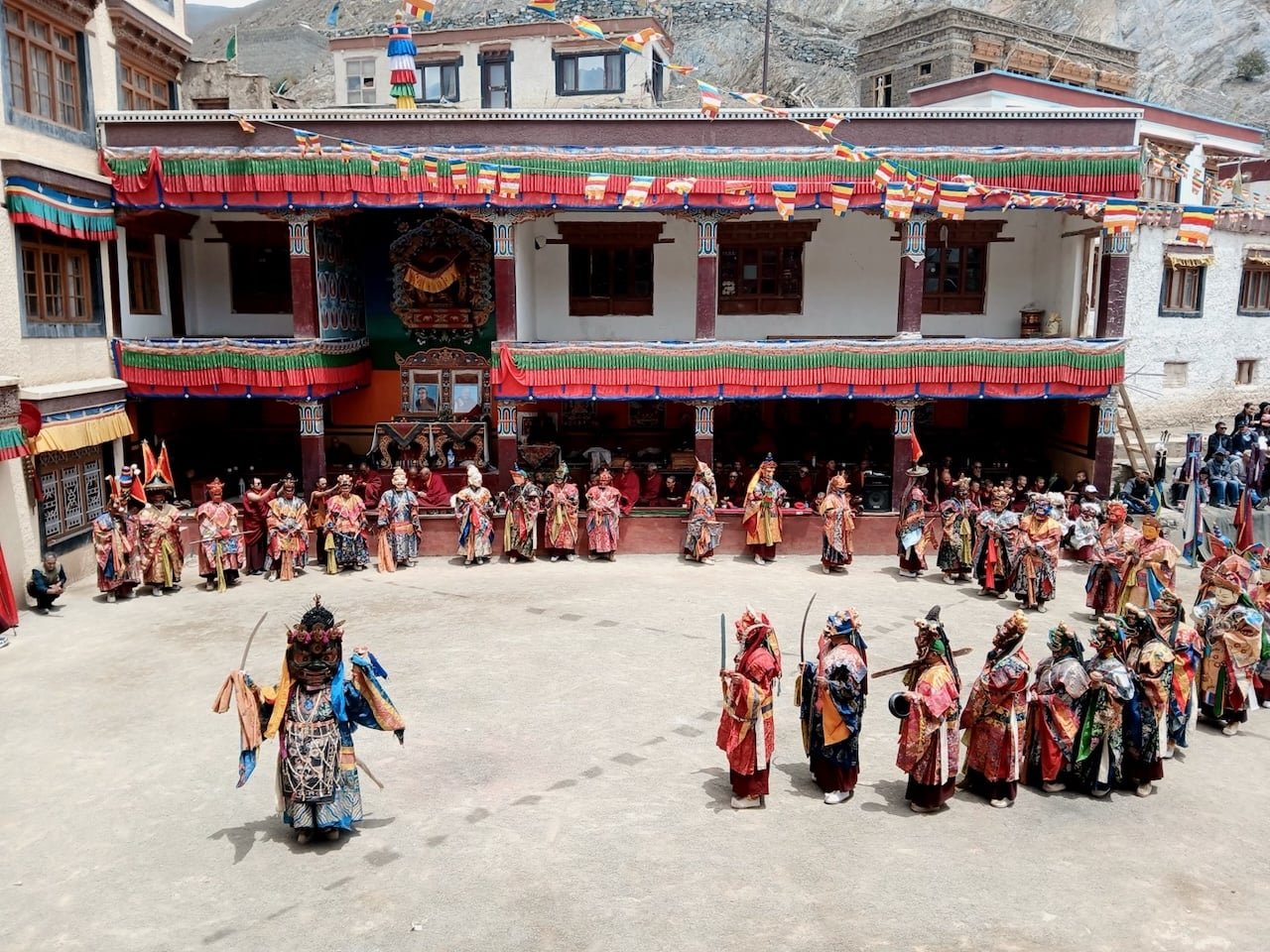
Dance is not simply a repository of cultural information. Dance is an intelligence in its own right. It carries inherited knowledge, but also discovers new possibilities through the act of dancing. It survives by adapting, crossing boundaries, and finding new bodies through which to express itself. Dance gets by. Kingdoms fall, societies change, but dance gets by. This understanding has profound implications for ancient and endangered dance traditions, including those of Buddhist Asia.
Consider the legendary journeys of the dancing wizard Guru Rinpoche, Padmasambhava, through the cultural worlds of Gandhara, Nepal, Bhutan, and Tibet. His story, woven from history, legend, and religious imagination, traces and parallels the actual movement of tantric and yogic knowledge—embodied as dance and meditation practices—across vast geographical and cultural distances.
Dance is a significant part of this transformative religious world. Through gesture, movement, visualization, and the embodiment of enlightened qualities, yogic practices take physical form; dance is the meditation.
The legends of Guru Rinpoche suggest a transmission of spiritual intelligence that does not remain fixed in one place, one dimension, or one cultural expression, but moves, adapts, and becomes rooted in new communities, establishing evolved new dances. Padmasambhava moved between centers of experimental yogic activity.
This does not mean there was a single continuous choreography by one man, from ancient Gandhara to contemporary Tibet. Rather, it suggests something more interesting: a continuing intelligence of embodied transformation, capable of assuming different forms as it travels. Dance as intelligence.
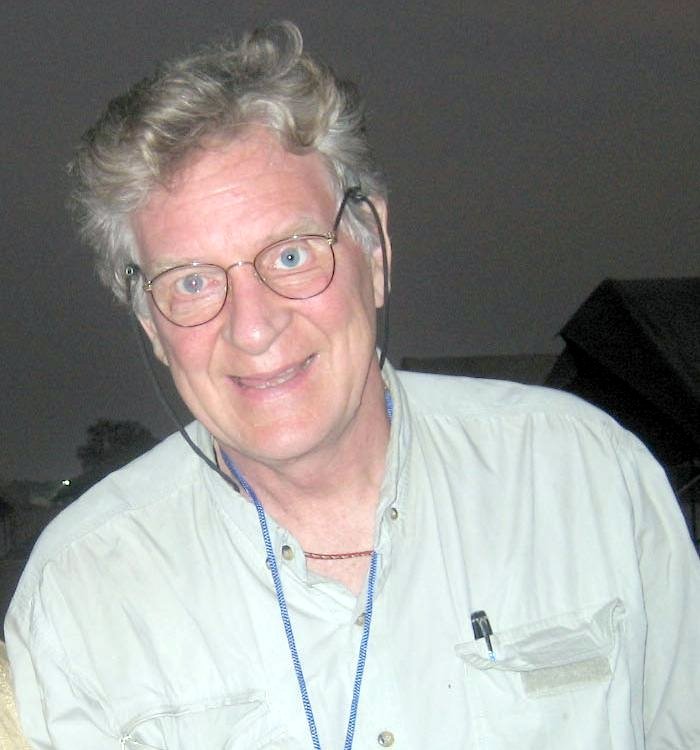
A living example is found in the Newar Buddhist tantric priest and dancer Prajwal Vajracharya, who teaches Charya Nritya, an ancient tradition of Buddhist ritual dance preserved within the hereditary Vajracharya priesthood of Nepal’s Kathmandu Valley.
In Charya Nritya, dance is not simply a representation of Buddhist deities or religious stories. Through mudra, movement, visualization, and disciplined practice, the dancer engages in a process of psychophysical transformation. The body itself becomes an instrument of religious understanding. Such knowledge cannot be fully recovered from manuscripts, sculptures, or paintings alone. It must be enacted. The practitioner enters a disciplined process through which that experience becomes possible.
Prajwal’s worldwide teaching also can be seen as a parallel with Dance Theatre of Harlem. Historically, Charya Nritya was transmitted within particular hereditary and initiatory communities. Today, as instructed by his father, Prajwal teaches students from many countries and cultural backgrounds, extending aspects of this ancient practice beyond the community that preserved it. I have seen students of Prajwal dance in long tantric rituals. It looks like nothing else and is a liberated ecstatic form.
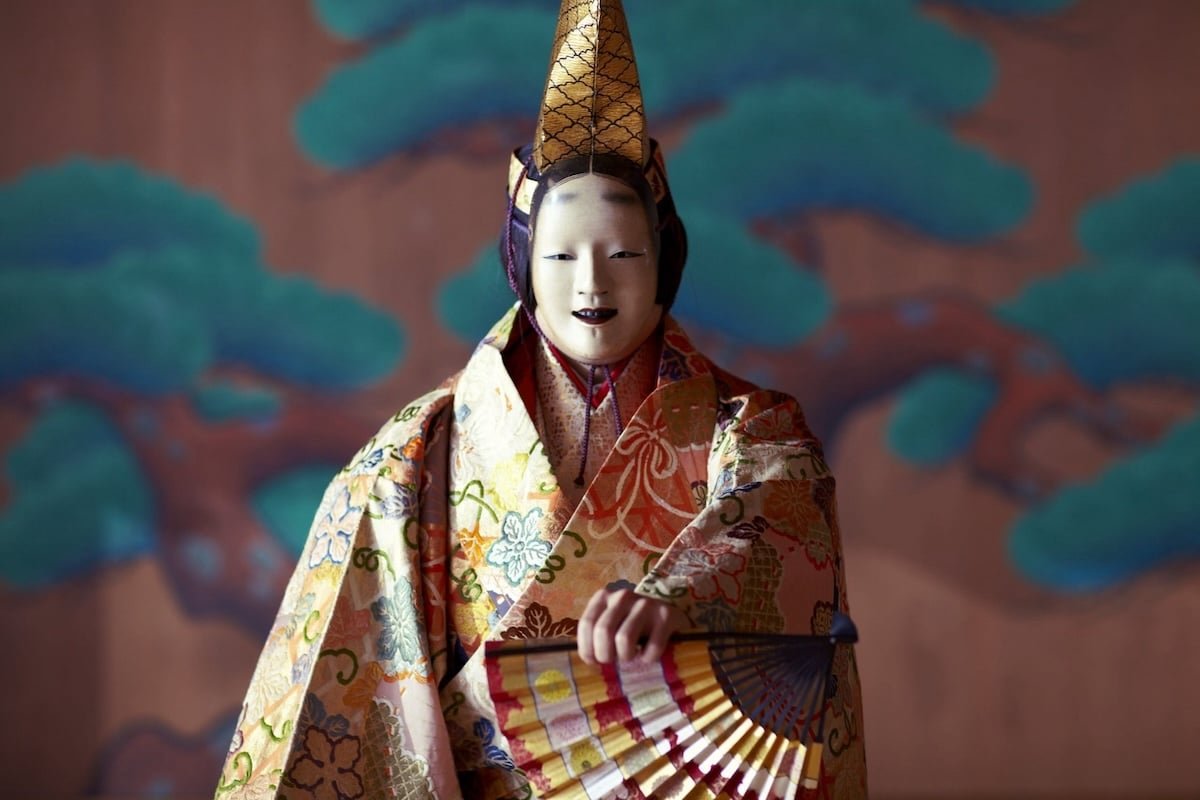
Dance Theatre of Harlem similarly challenged historical restrictions concerning who could embody classical ballet, expanded what ballet can be and, by now, is part of the Story of Ballet. The circumstances are profoundly different. Racial exclusion from European concert dance is not equivalent to the traditional religious requirements for esoteric Buddhist practice. But both examples invite fundamental questions: Who may inherit a movement tradition? And what happens when its knowledge enters bodies outside the community of its original practitioners? The question pertains widely: to monks, nuns, Noh actors, clan performers, and any closed dance society.
Cultural intelligence expands when inherited barriers to participation are reconsidered, when new practitioners gain access to profound forms of knowledge, and when traditions discover possibilities beyond the circumstances of their origins. This is how dance works.
Dance Theatre of Harlem in the finale of The Firebird. Photo by Jose Calvo. Image courtesy of Dance Theatre of Harlem.
This expansion is not automatic, nor does every change preserve what is essential. Buddhist ritual dances may depend on initiations, religious understandings, and relationships between teachers and disciples, based on lifetimes of meditation. Their purposes differ fundamentally from theatrical entertainment. Preserving a choreography is not necessarily the same as preserving the tradition that gives it meaning.
Yet dance possesses a remarkable capacity to continue. Through wars, migrations, religious transformations, changing patronage, and shifting cultural values, dance gets by. Sometimes magnificently, sometimes precariously, sometimes in forms barely recognizable to earlier generations. But dance is intelligent. It knows what it is doing.
When a living dance tradition disappears, humanity may lose more than a beautiful performance or an interesting historical record. We may lose a way of knowing, a way of cultivating consciousness, a way of experiencing reality. This is what fascinates me and drives my work.
The Firebird’s ascent above the Auditorium Theater’s stage reminds us what a cultural inheritance really is. A living art form, a seed of genius, can travel across time, across continents, change its performers, acquire new imagery, and still communicate something of the original imaginative power. Perhaps this is one of dance’s greatest gifts? The chance to see a Firebird in flight? What is more auspicious?
See more
Core of Culture
Related features from BDG
Messengers of Mind, Cultural Explorers and the Encounter with Buddhism, Part One: A Gallery of ExplorersThe Acrobat FamilyJardin aux Lilas, the First Zen Ballet
More from Ancient Dances by Joseph Houseal
The post The Firebird Flies Again appeared first on Buddhistdoor Global.